Product Designer Interview Questions (2026)
5 min read20 practice questionsUpdated Sep 29, 2026
Product designer interviews test craft, process, and product thinking — often all in a single 45-minute session. Companies like Figma, Shopify, and Meta look for designers who can frame a problem clearly, move through ambiguity, connect design decisions to user and business outcomes, and present their work with confidence. This guide covers every question type you'll encounter: portfolio walkthroughs, live design challenges, cross-functional collaboration scenarios, and the metrics questions that increasingly separate strong candidates in 2026.
Hear how your answer lands before the interview
“Walk me through a project in your portfolio that you are most proud of. What was your specific contribution?”
Rehearse my answerFree · no account needed
Product Designer Interview Questions
Cultural Fit Questions
2 questions- 1
What does good design look like to you, and where did that philosophy come from?
Entry-levelHow to answer: Be specific and personal. Reference designers, products, or principles that genuinely shaped your thinking. Interviewers want to understand your taste and your values — generic answers like "clean and minimal" reveal nothing.
- 2
What is the hardest part of being a product designer in a fast-moving environment?
SeniorHow to answer: This is a self-awareness question. Genuine answers cover: maintaining design quality under time pressure, advocating for user-centered thinking when business urgency dominates, and dealing with designs shipping in forms you didn't intend. Show you have strategies, not just frustrations.
“Tell me about yourself”, “Why here?” and the other common questions, and how to prep each →
Behavioral Questions
7 questions- 1
Walk me through a project in your portfolio that you are most proud of. What was your specific contribution?
Entry-levelHow to answer: Structure your answer: context (the problem and constraints), your process (research, ideation, iteration), your role specifically, the solution, and the outcome (metrics if available). Be honest about what was collaborative vs your individual contribution.
- 2
Tell me about a design decision you made that you later regretted. What did you learn?
Mid-levelHow to answer: Intellectual honesty is a signal of design maturity. Describe a specific decision, the context you had at the time, what you discovered after shipping, and how it changed your process. Avoid vague answers like "I would always do more research now".
- 3
Describe a project where you had to advocate for the user when business or engineering constraints pushed back.
SeniorHow to answer: Show you can influence through evidence: user research, usability data, or a clear articulation of user harm. Discuss how you built alignment rather than simply winning an argument. The best answers show collaborative resolution, not adversarial design politics.
- 4
How do you decide when you have done enough user research to proceed to design?
Mid-levelHow to answer: Discuss saturation — when interviews stop surfacing new insights. But also acknowledge constraints: sometimes you design with limited research and plan validated learning post-launch. Show pragmatism alongside rigor. Avoid implying you always do exhaustive research before touching Figma.
- 5
How do you handle a situation where engineering says your design is not feasible to build in the given timeline?
Mid-levelHow to answer: Show you solve problems collaboratively, not defensively. Discuss: pairing with engineers early to uncover constraints before designs are finalised, prioritizing the core user need vs nice-to-have elements, and proposing a phased approach that ships the essential experience now.
- 6
How do you involve product managers and engineers in the design process?
Mid-levelHow to answer: Design is a team sport. Describe your practices: early alignment on problem framing, design crits open to all, engineers in usability sessions, shared design system ownership. The best designers create shared understanding, not just deliverables.
- 7
How do you give and receive design critique constructively?
Mid-levelHow to answer: Great designers critique the work, not the person. Describe your practice for giving critique (specific, tied to the problem statement, framed as questions) and receiving it (separating your ego from your output, seeking to understand the critique before defending). Design review culture varies significantly by company.
The six topics behind behavioral questions, and how to prep a story for each →
Product Questions
8 questions- 1
How would you redesign the checkout experience for an e-commerce app to reduce cart abandonment?
Mid-levelHow to answer: Start with research hypotheses (why do users abandon? friction, trust, payment options). Then structure a design approach: reduce steps, guest checkout, progress indicators, save-for-later, trust signals. Define success metrics (checkout completion rate, time to purchase). Show process, not just wireframes.
- 2
Design an app feature that helps users manage chronic medication schedules.
Mid-levelHow to answer: This is a healthcare UX problem. Show user empathy: cognitive load of managing medication is high, stakes are real. Consider accessibility (large text, voice input), reminders that don't create anxiety, and the emotional context of illness. Connect every design choice to a user need.
- 3
How would you approach designing for a feature used by both power users and complete beginners?
SeniorHow to answer: Discuss progressive disclosure: expose basic functionality by default, reveal advanced options contextually or in settings. Reference examples like Figma's interface, which scales from simple shapes to complex component libraries. Show you have a mental model for designing across skill levels.
- 4
Walk me through your end-to-end design process for a new product from scratch.
Mid-levelHow to answer: Cover: discovery (stakeholder alignment, user research, market analysis), define (problem statement, user personas, success metrics), design (ideation, wireframes, prototyping, iteration), and deliver (handoff specs, developer QA, post-launch review). Adapt based on company maturity — a startup process differs from a FAANG process.
- 5
How do you translate qualitative research findings into actionable design decisions?
Mid-levelHow to answer: Discuss synthesis methods: affinity diagramming, Jobs to Be Done frameworks, user journey mapping, and prioritization of pain points by frequency and severity. Show how you connect insights to specific design choices rather than using research as decorative validation.
- 6
How do you measure the success of a design?
Mid-levelHow to answer: Go beyond "it looks good". Discuss: task completion rate, time on task, error rate (usability metrics), engagement metrics (DAU, session depth), and business outcomes (conversion, retention, NPS). Connect your design decisions to measurable user and business impact.
- 7
What does accessibility mean in your design practice and how do you implement it?
Mid-levelHow to answer: Accessibility is not a checklist — it's a mindset. Discuss WCAG 2.1 AA at minimum (contrast ratios, tap targets, keyboard navigation, screen reader support), how you involve users with disabilities in research, and how you advocate for accessibility when it is deprioritised.
- 8
How do you balance aesthetic quality with functional usability when they conflict?
SeniorHow to answer: Show mature design judgement: form should follow function in product design, but aesthetics create trust and reduce cognitive friction. Discuss specific examples where you made trade-offs and how you used testing to validate the right balance for that context.
Technical Questions
1 question- 1
How do you approach building or contributing to a design system?
SeniorHow to answer: Show you understand design systems as products: components should solve real, recurring problems — not be built speculatively. Discuss governance (who can add components, how are they documented?), contribution workflows, and how you balance consistency with team autonomy.
Case Study Questions
2 questions- 1
You have 10 days and a $0 research budget. How do you validate a design hypothesis?
Entry-levelHow to answer: Guerrilla research: 5-second tests (Usability Hub), café testing, hallway testing with colleagues, unmoderated remote tests (Maze, Lyssna), or analyzing existing session recordings (FullStory, Hotjar). Show you are creative and resourceful, not dependent on resources.
- 2
A feature you designed has launched but metrics are flat. How do you investigate?
SeniorHow to answer: Structured approach: check if the feature is being discovered (reach), watch session recordings for usage patterns, run a quick usability study with 3–5 users, review qualitative feedback (app store reviews, support tickets). Then hypothesise causes: discoverability, value proposition clarity, or friction in the flow.
Rehearse this one out loud:
“Walk me through a project in your portfolio that you are most proud of. What was your specific contribution?”
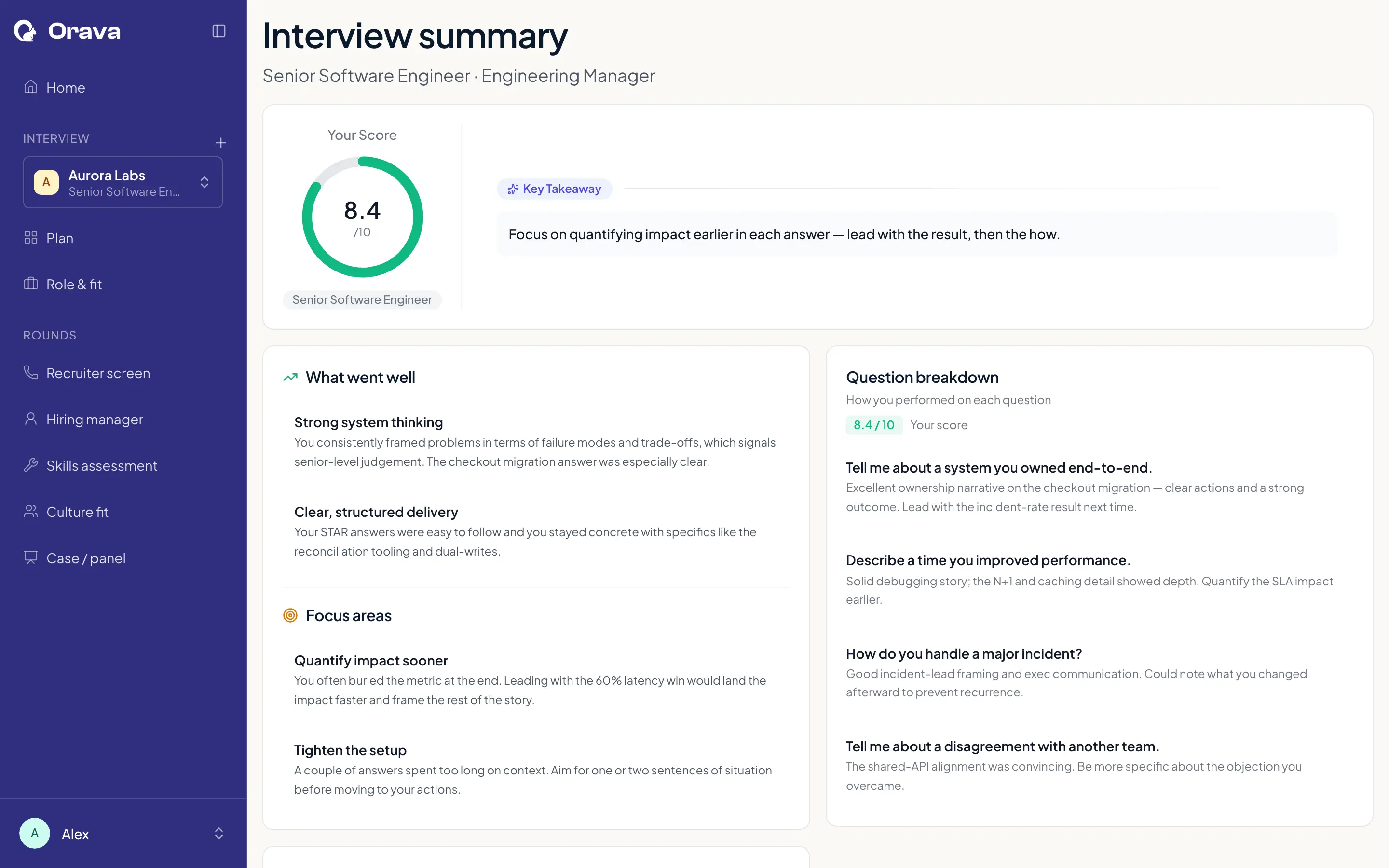
How to Prepare for Product Designer Interviews
- Your portfolio is your primary interview material. Curate 3–5 deep case studies over a large number of shallow ones. Each should show your problem-framing, research process, design decisions, iteration, and measurable outcome. Interviewers spend more time on depth than breadth.
- Practice presenting your portfolio out loud under time pressure. Most design interviews allocate 20–30 minutes for portfolio walkthrough. Timing matters — running over on one project means you never get to show your best work.
- Know how to talk about metrics. "Users loved it" is not an outcome. Prepare specific numbers for each case study: completion rates, engagement lift, NPS improvement, or reduction in support tickets. Even estimates are better than nothing.
- Research the company's product and design language before your interview. Have genuine, specific opinions about what they do well and where you see opportunity. Companies at Figma, Shopify, and Spotify explicitly test for product taste — be ready to critique their own interfaces respectfully.
- Be able to articulate your design philosophy in one sentence, and back it up with examples. Whether it's "design should reduce cognitive load" or "great design makes the complex feel simple", your philosophy should be consistent across your portfolio and your answers.
- For design challenge exercises (live or take-home), prioritize demonstrating your thinking over the visual polish of your output. A rough wireframe with excellent rationale beats a beautiful design with no clear user problem. Narrate your decisions explicitly.
- Understand the basics of front-end development: CSS box model, responsive design patterns, component architecture. You don't need to code, but designers who understand engineering constraints ship better designs and earn more trust from their teams.
Product Designer Interview — Frequently Asked Questions
Most product designer interview processes include 4–6 stages: (1) recruiter screen (background and motivation, 30 min), (2) portfolio review with the hiring manager (45–60 min), (3) a design challenge — either a take-home exercise (2–4 hours) or a live whiteboard/Figma session (45–60 min), (4) cross-functional interviews covering collaboration with PMs and engineers, research approach, and behavioral questions, and sometimes (5) a final portfolio presentation to a panel. The process typically takes 3–7 weeks. Companies like Figma and Shopify are known for rigorous, multi-stage design processes.
The titles are often used interchangeably, but there is a meaningful distinction in practice. UX designers tend to focus on user research, information architecture, and usability — the "experience" layer. Product designers take a broader ownership: they are involved in product strategy, business outcomes, and work more closely with PM and engineering to define what gets built, not just how it is experienced. At many top tech companies (Figma, Meta, Stripe), "product designer" is the standard title and encompasses both UX and visual design responsibilities.
No — you do not need to write production code. But a working understanding of HTML, CSS, and how component-based front-end frameworks work (React, etc.) is a significant advantage. It helps you spec designs accurately, understand what is technically feasible, and communicate more effectively with engineers. Some companies (especially startups) value designers who can prototype in code. Tools like Framer blur the line between design and code. At minimum, understand responsive design, design tokens, and how your design system translates to component libraries.
Figma places very high emphasis on systems thinking and product taste — you're expected to have deep opinions about design tools and the design craft itself. They value technical depth alongside strong visual sensibility. Meta design interviews are product-metric-driven: they want to see that you connect design decisions to business and user outcomes, not just aesthetics. Shopify values a "merchant-obsessed" mindset and entrepreneurial thinking — they want designers who understand commerce deeply. See the Figma Product Designer, Meta Product Designer, and Shopify Product Designer guides for company-specific prep.
Product designer compensation varies significantly by company and seniority. Pay varies by level, location and team. Many postings list a base-pay range (US postings in states such as California and New York are required to), so check the posting for your role and ask your recruiter how equity and any bonus work at your level.
For a take-home challenge: read the brief twice before starting. Structure your response around the problem, not the solution — spend at least 30% of your effort on framing the user problem and constraints. Show your thinking: use annotated wireframes, explain trade-offs, and include a section on "what I would do with more time". For a live whiteboard challenge: ask clarifying questions first, think out loud throughout, and prioritize breadth (covering the full scope) over depth (polishing one screen). Start with a rough sketch and iterate — don't start in a tool until you've aligned on the direction.
The most important preparation for a design interview is portfolio work — not study. Spend 4–6 weeks before your target interview dates refining 3–4 deep case studies with clear problem framing, process documentation, and measurable outcomes. Alongside that, practice presenting your portfolio out loud (target 25 minutes) and rehearse design challenge frameworks. Research the target company's products and design system in the final week. The most common mistake is presenting too many projects too shallowly — depth signals craft, breadth does not.
Applying for this role?
Paste the Product Designer posting and your resume. See which requirements your resume already proves, and which answers to prepare first.
Compare my resume to this roleFree · no account needed