Amazon Product Manager Interview Questions (2026) – Preparation Guide
5 min read16 practice questionsUpdated Sep 29, 2026
Product Manager interviews test how you frame a product problem, decide what to measure and make a call with incomplete information. This guide gives cultural fit, behavioral, product, technical, system design, case study and leadership practice questions for the Amazon loop, with notes on how to answer them.
Hear how your answer lands before the interview
“Tell me about a time you showed Ownership end‑to‑end on a high‑stakes launch.”
Rehearse my answerFree · no account needed
Sample Amazon Product Manager Interview Questions
Cultural Fit Questions
1 question- 1
How do you demonstrate fit with Amazon’s culture using the Working Backwards method?
Mid-levelHow to answer: Reference PR/FAQ; tie decisions to customer impact and LPs.
“Tell me about yourself”, “Why here?” and the other common questions, and how to prep each →
Behavioral Questions
4 questions- 1
Tell me about a time you showed Ownership end‑to‑end on a high‑stakes launch.
Mid-levelHow to answer: Use STAR; quantify results and trade‑offs.
- 2
Describe a situation where you had to Disagree and Commit with a senior stakeholder.
SeniorHow to answer: Show backbone, respectful challenge, and measurable outcome.
- 3
Give an example of when you had to Dive Deep to find the real root cause behind a metric drop.
Mid-levelHow to answer: Share your hypothesis tree, data pulled, and the fix that moved the metric.
- 4
Tell me about a time a launch failed and what you did next.
SeniorHow to answer: Own root cause, mitigation, and lessons applied later.
The six topics behind behavioral questions, and how to prep a story for each →
Product Questions
4 questions- 1
How would you improve Amazon Prime onboarding to increase activation and retention?
SeniorHow to answer: Map funnel, propose experiments, define leading/lagging metrics.
- 2
How would you prioritize features for Amazon’s mobile app with limited engineering capacity?
Mid-levelHow to answer: Use RICE or value/effort; justify by customer impact and LTV.
- 3
What product strategy would you propose to grow Seller success on Amazon Marketplace?
SeniorHow to answer: Segment sellers, identify JTBD, outline roadmap and success metrics.
- 4
Which metrics would you track to judge the success of Alexa voice shopping?
Mid-levelHow to answer: Adoption, repeat usage, error rate, CSAT, ecosystem attach.
Technical Questions
2 questions- 1
How would you implement an experiment to optimize product detail page conversion?
Mid-levelHow to answer: Assignment, power, metrics, guardrails; instrumentation & rollout.
- 2
How would you debug and optimize latency on a high‑traffic checkout flow?
SeniorHow to answer: Tracing, bottlenecks, error budgets, customer impact of fixes.
System Design Questions
1 question- 1
Design the architecture for personalized recommendations on the Amazon mobile app.
SeniorHow to answer: Signals, batch vs real‑time, caching, feedback loops, cost/latency trade‑offs.
Case Study Questions
2 questions- 1
Analyze a 10% decline in Amazon Fresh weekly orders and propose a plan to recover growth.
SeniorHow to answer: Diagnose cohorts/regions, form hypotheses, design experiments, set guardrails.
- 2
Investigate a drop in Prime Video engagement after a UI change and recommend actions.
Mid-levelHow to answer: Compare treatment/control, root‑cause, propose fixes and re‑tests.
Leadership Questions
2 questions- 1
How do you lead cross‑functional teams to deliver a multi‑org launch on time?
SeniorHow to answer: Stakeholder map, decision log, risks/mitigations, status cadence.
- 2
How would you mentor junior PMs to raise the bar on PR/FAQ quality?
Mid-levelHow to answer: Templates, exemplars, review cadence, measurable standards.
Rehearse this one out loud:
“Tell me about a time you showed Ownership end‑to‑end on a high‑stakes launch.”
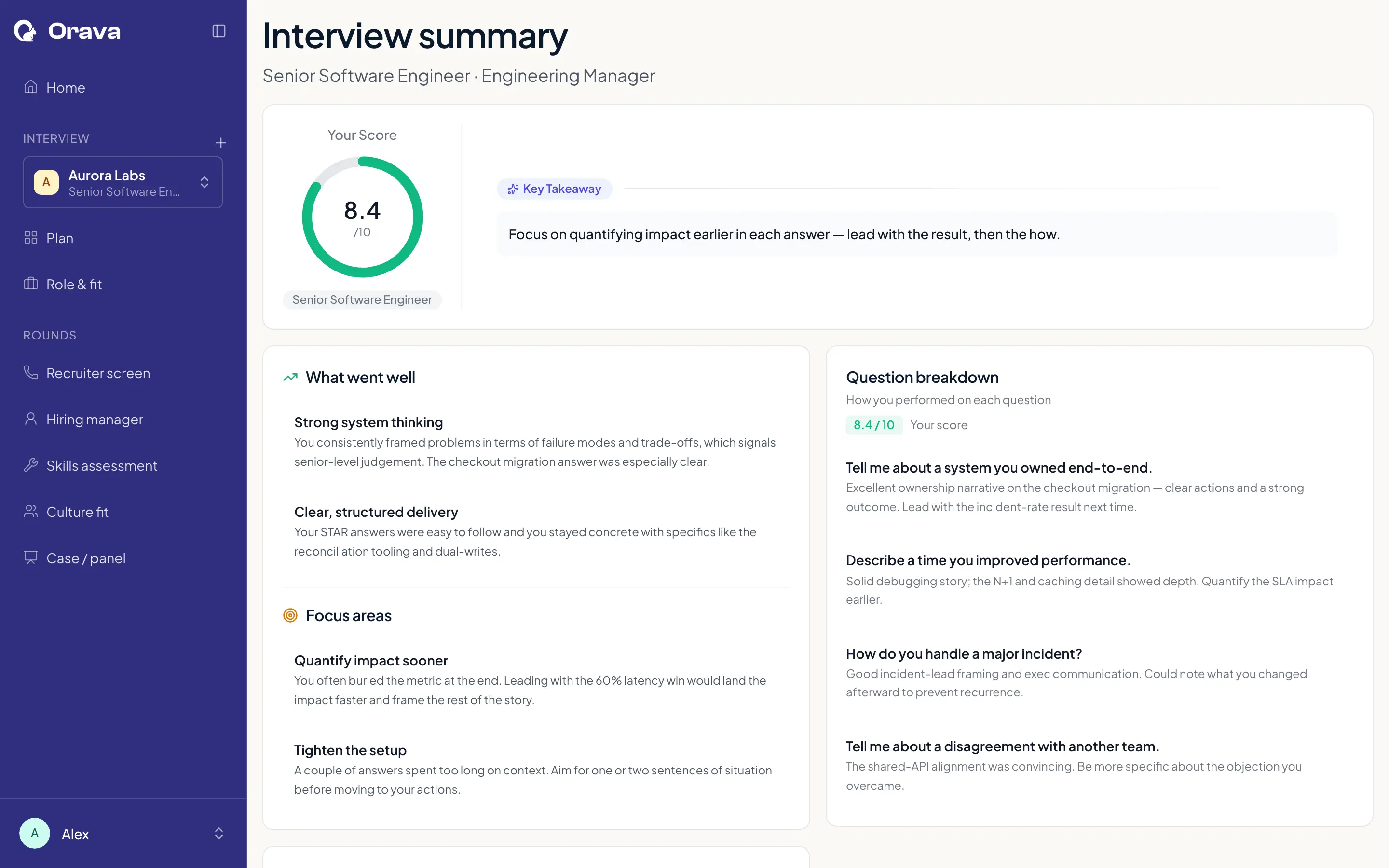
Preparation Tips for Amazon Product Manager Interviews
- Master the 16 Leadership Principles; prep 2–3 STAR stories with metrics.
- Practice Working Backwards; write a PR/FAQ with clear success metrics.
- Prep for Bar Raiser; justify decisions with data and customer impact.
- Balance short vs long term; show when you chose durable value.
- Know your metrics; define leading + lagging indicators fast.
- Understand Amazon’s ecosystem: Prime, AWS, Alexa, Marketplace.
- Show technical fluency: APIs, system design trade‑offs, constraints.
- Own failures; bring one post‑mortem with root cause and lessons.
Frequently Asked Questions - Amazon Product Manager
The Amazon PM role is guided by 16 Leadership Principles, including Customer Obsession, Ownership, Invent and Simplify, Dive Deep, Bias for Action, Think Big, and Deliver Results. Prepare STAR stories with measurable customer impact and long‑term outcomes.
Prepare 2–3 STAR stories per high‑signal principle (Ownership, Customer Obsession, Dive Deep). Cover problem, analysis, trade‑offs, stakeholders, and quantified results. Expect probing Bar Raiser follow‑ups.
The Amazon PM interview process typically takes 4–6 weeks and includes recruiter screen, phone interviews, onsite product and leadership rounds, and a final Bar Raiser interview.
Pay varies by level, location and team. Many postings list a base-pay range (US postings in states such as California and New York are required to), so check the posting for your role and ask your recruiter how equity and any bonus work at your level.
The Bar Raiser is a trained interviewer who ensures long-term hiring quality. They probe deeply on Leadership Principles breadth and mechanism thinking. Expect follow-ups that push past surface metrics into root causes and durable solutions. Prepare layered STAR stories (baseline → deeper insight → mechanism you built) and be explicit about counterfactual impact if you hadn't acted.
Use Working Backwards: 1) Press Release (customer headline + why it matters), 2) FAQs (customer, business, operations, edge cases), 3) Metrics (leading + lagging + guardrails), 4) Tenets (decision filters), 5) Rollout / risks. Keep narrative crisp, quantify impact, and anchor every feature to a customer problem + LP.
Define a primary customer value metric (retention, adoption, conversion) + input metrics (latency, selection breadth, defect rate) + guardrails (CX defect %, cost per action). Show how you'd instrument them and what thresholds trigger investigation. Tie each to a Leadership Principle (e.g., latency to Customer Obsession, defect rate to Highest Standards).
Master LP-aligned STAR stories (2–3 each high-signal), practice Working Backwards PR/FAQ writing, drill metrics framing (input vs output vs guardrail), system/product strategy trade-offs (customer value, scalability), and Bar Raiser depth follow-ups. Allocate prep: 40% behavioral LP depth, 30% product strategy, 20% metrics/analytical, 10% mock PR/FAQ reps.
Applying for this role?
Paste the Amazon posting and your resume. See which requirements your resume already proves, and which answers to prepare first.
Compare my resume to this roleFree · no account needed