
Anthropic Research Engineer Interview Questions & Process (2026)
4 min read12 practice questionsUpdated Sep 29, 2026
Research Engineer interviews test how you reason through a technical problem out loud: the approach you pick, the trade-offs you name and how you check your work. This guide walks through the Anthropic process stage by stage, then gives cultural fit, behavioral, product, technical, system design and case study practice questions with notes on how to answer them.
Hear how your answer lands before the interview
“Tell me about a time you had to build infrastructure or tooling for a research problem that wasn't fully specified yet.”
Rehearse my answerFree · no account needed
The Anthropic Research Engineer Interview Process
What to expect at each stage of the Anthropic Research Engineer loop.
- 1
Introductory conversation
Your background, motivation, and which Research Engineer team (Pretraining, Interpretability, RL Engineering, Model Evaluations, etc.) you're interviewing for.
- 2
Engineering deep dive
A close look at prior engineering work — architecture decisions, debugging under ambiguity, and how you validated correctness at scale.
- 3
Technical exercise
Role-relevant coding or systems problem. Anthropic notes technical interviews may use tools such as Colab or CodeSignal.
- 4
Research judgment
How you'd approach an underspecified research-infrastructure problem — prioritization, validation, and communicating results to researchers.
- 5
Team and mission conversations
Fit with the specific team, collaboration style, and motivation for Anthropic's safety-focused mission.
Sample Anthropic Research Engineer Interview Questions
Cultural Fit Questions
2 questions- 1
Anthropic says engineers do lots of research and researchers do lots of engineering. How would you describe your own position on that spectrum, and what's a concrete example?
How to answer: Don't just say you're 'somewhere in the middle.' Give one real example where you moved from engineering into a research judgment call (e.g., changing an experiment's design because of what the infrastructure revealed), and one where research understanding shaped an engineering decision.
- 2
Anthropic's Research Engineer postings span teams like Interpretability, RL Engineering, and Model Evaluations. Which pulls you, and what would your first 90 days look like?
How to answer: Show you've read the specific team's posting, not just 'Anthropic' generically. Name concrete first steps: understanding the existing codebase, shipping a small improvement, then taking on a larger project.
“Tell me about yourself”, “Why here?” and the other common questions, and how to prep each →
Behavioral Questions
4 questions- 1
Tell me about a time you had to build infrastructure or tooling for a research problem that wasn't fully specified yet.
How to answer: Use STAR. Emphasize how you scoped the ambiguity, what you built first to get signal quickly, and how the tooling evolved as the research direction became clearer.
- 2
Describe a situation where an experiment or training run failed in a way that took real debugging effort to understand. Walk through your process.
How to answer: Show a systematic debugging approach — instrumentation, isolating variables, forming and testing hypotheses — not just 'I found the bug.' Mention what you changed afterward to catch similar issues earlier.
- 3
Tell me about a time you disagreed with a research collaborator about the right technical approach. How did you resolve it?
How to answer: Anthropic's culture values intellectual honesty and pushing back respectfully. Show you can hold a technical position, engage the counterargument seriously, and change your mind when the evidence warrants it.
- 4
Describe a time you had to make a decision under safety or risk considerations that traded off against speed or performance.
How to answer: Connect to Anthropic's safety-first framing without reciting talking points — use a real (or realistic, if hypothetical) example of choosing a slower-but-safer path and explain the reasoning.
The six topics behind behavioral questions, and how to prep a story for each →
Product Questions
1 question- 1
How would you prioritize between building a one-off script to unblock a researcher today versus investing in reusable infrastructure?
How to answer: There's no single right answer — show judgment about urgency, how often the need will recur, and the cost of technical debt in a fast-moving research codebase.
Technical Questions
3 questions- 1
Explain how you'd approach optimizing a distributed training run that is bottlenecked but you don't yet know where.
How to answer: Discuss profiling methodology (compute vs. communication vs. I/O bound), tools you'd use, and how you'd validate a fix didn't silently change training behavior (e.g., loss curves, numerical parity checks).
- 2
Walk through how you'd implement and validate a new component in a training pipeline (e.g., a new data loader, a new RL reward signal, or a new eval metric).
How to answer: Emphasize correctness validation before scale — small-scale sanity checks, unit tests where possible, and comparison against a known-good baseline before trusting results at full scale.
- 3
How do you think about reproducibility when running many parallel experiments across a research team?
How to answer: Discuss config management, seeding, environment/version pinning, and experiment tracking — and the trade-off between reproducibility rigor and research iteration speed.
System Design Questions
1 question- 1
How would you design an evaluation harness that needs to run reliably across many model checkpoints during a long training run?
How to answer: Cover checkpoint scheduling, compute cost trade-offs, flakiness/retry handling, result storage and comparison over time, and how you'd surface regressions to researchers quickly.
System design questions grouped by the concept they test, with a full walkthrough →
Case Study Questions
1 question- 1
You're asked to speed up a research team's iteration loop, which currently takes a day per experiment. What would you investigate first?
How to answer: Prioritize by leverage: is the bottleneck compute allocation, data pipeline throughput, evaluation cost, or engineering friction in launching experiments? Show how you'd measure before optimizing.
Rehearse this one out loud:
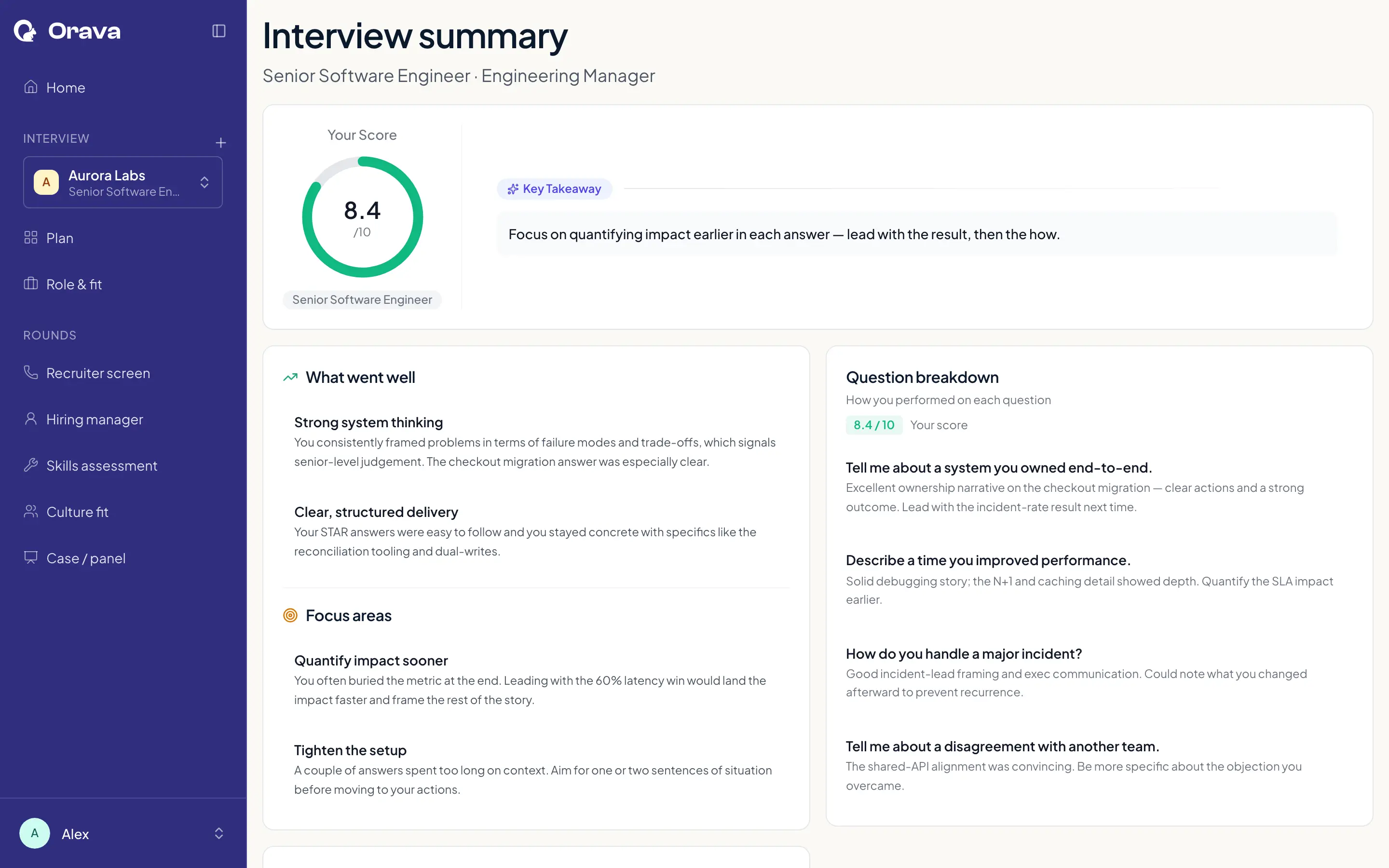
“Tell me about a time you had to build infrastructure or tooling for a research problem that wasn't fully specified yet.”
Preparation Tips for Anthropic Research Engineer Interviews
- Read Anthropic's published research (anthropic.com/research) before your interview and be ready to discuss one paper in technical depth, including what you'd try next.
- Prepare one detailed engineering story that shows you can take a research idea from rough sketch to working, validated code — this is the core of the role.
- Practice explaining debugging methodology out loud, not just conclusions — interviewers care about your process for isolating hard, ambiguous bugs.
- Since Research Engineer postings are team-specific (Pretraining, Interpretability, RL Engineering, etc.), tailor your prep to the actual team you're interviewing with rather than generic ML trivia.
- Be ready to discuss trade-offs between engineering rigor (tests, reproducibility) and research iteration speed — Anthropic wants engineers who can navigate that tension, not dogmatically pick one side.
- If your technical exercise uses Colab or CodeSignal, practice writing and debugging code in a notebook-style environment beforehand, since it differs from a typical local dev setup.
Frequently Asked Questions - Anthropic Research Engineer
A Research Engineer at Anthropic builds the code, infrastructure, and experiments that make frontier model research possible — training pipelines, evaluation harnesses, RL infrastructure, and the tooling researchers use daily. Anthropic hires dozens of Research Engineers into specific teams (Pretraining, Discovery, Interpretability, RL Engineering, Model Evaluations, and others), and the company explicitly says 'engineers do lots of research, and researchers do lots of engineering' — Research Engineers are frequently paper authors, sometimes first author.
Anthropic's interviews are remote and tailored to the candidate's background and the specific team. Expect an initial conversation about your background and motivation, a deep dive into your prior engineering or research work, a technical exercise (Anthropic notes technical interviews may use tools like Colab or CodeSignal), and team/mission-fit conversations. Because Research Engineer postings span many teams, the exact sequence and technical focus vary — confirm with your recruiter which team-specific modules apply.
Strong software engineering fundamentals (clean code, testing, debugging complex systems) combined with the ability to work inside a research codebase — implementing new architectures, running and iterating on experiments quickly, and reasoning about numerical and distributed-systems correctness. Depending on the team, this can mean deep PyTorch and distributed training experience (Pretraining, RL Engineering), evaluation and benchmarking infrastructure (Model Evaluations), or interpretability tooling (Interpretability).
Anthropic's own postings list an annual salary range of roughly $350,000–$850,000 for Research Engineer roles, varying substantially by level, team, and location. Treat this as a reported range from live postings rather than a guarantee for any individual offer.
Not necessarily. Anthropic explicitly recruits engineers without a traditional research pedigree, on the premise that strong engineers can grow into research contributors inside its research-heavy culture. That said, candidates who can speak concretely about experiments they've run, results they've interpreted, or systems they've debugged under ambiguity tend to perform best, since the role blends engineering execution with research judgment.
The two roles sit on a spectrum rather than being sharply divided. Research Scientists more often originate research directions and own experimental design end to end; Research Engineers more often turn research problems into working, scalable code — training infrastructure, RL environments, evaluation pipelines — while still contributing to the underlying research questions. Anthropic's own description of engineers as frequent paper co-authors (and sometimes first authors) reflects how much the two roles overlap in practice.
Sources
Applying for this role?
Paste the Anthropic posting and your resume. See which requirements your resume already proves, and which answers to prepare first.
Compare my resume to this roleFree · no account needed

