Software Engineer Interview Questions (2026)
6 min read21 practice questionsUpdated Sep 29, 2026
Software engineer interviews in 2026 follow recognizable patterns across Google, Meta, Amazon, Apple, and other top companies — but knowing what to expect is only half the battle. This guide covers the complete spectrum: from entry-level coding rounds to senior system design interviews, behavioral assessments, and the cultural signals that separate hired candidates from the rest. Whether you're targeting FAANG or a fast-growing startup, these questions and strategies will prepare you for the real thing.
Hear how your answer lands before the interview
“Tell me about a time you had to make a technical decision with incomplete information.”
Rehearse my answerFree · no account needed
Software Engineer Interview Questions
Cultural Fit Questions
1 question- 1
How do you stay current with new technologies and engineering best practices?
Entry-levelHow to answer: Be specific: mention resources, communities, or projects you actively engage with. Interviewers want evidence of self-directed learning, not a generic answer.
“Tell me about yourself”, “Why here?” and the other common questions, and how to prep each →
Behavioral Questions
6 questions- 1
Tell me about a time you had to make a technical decision with incomplete information.
Mid-levelHow to answer: Use the STAR method. Show how you structured your reasoning, gathered what data you could, made a defensible call, and reviewed the outcome.
- 2
Describe a project where you had to balance technical debt against shipping on time.
Mid-levelHow to answer: Interviewers want to see pragmatism. Explain what trade-offs you made, how you documented them, and what your plan was to address the debt post-launch.
- 3
Tell me about a time you disagreed with a colleague's technical approach. How did you resolve it?
Mid-levelHow to answer: Show respect for other viewpoints, evidence-based reasoning, and the ability to influence through data — not authority.
- 4
Describe a situation where you had to debug a production issue under pressure.
SeniorHow to answer: Walk through your mental model: how you isolated the problem, tools you used, how you communicated status, and what post-mortem actions followed.
- 5
Tell me about the most complex system you've designed or contributed to.
SeniorHow to answer: Focus on architectural decisions — what alternatives you considered, the scale requirements, and how you validated your approach.
- 6
How do you decide when code is "good enough" to ship?
Mid-levelHow to answer: This is a product mindset question. Show you consider: correctness, maintainability, performance under expected load, test coverage, and business urgency — not just code aesthetics.
The six topics behind behavioral questions, and how to prep a story for each →
Technical Questions
9 questions- 1
Implement a function to find the two numbers in an array that sum to a target value.
Entry-levelHow to answer: Walk through brute force first (O(n²)), then optimize to O(n) using a hash map. Always discuss space/time trade-offs before writing code.
- 2
Given a binary tree, write a function to check if it is balanced.
Mid-levelHow to answer: A balanced tree has subtrees whose heights differ by at most 1. Implement a recursive post-order traversal returning height or -1 for unbalanced subtrees.
- 3
Implement an LRU (Least Recently Used) cache with O(1) get and put operations.
SeniorHow to answer: Use a doubly linked list combined with a hash map. The list maintains recency order; the map provides O(1) access. Explain eviction logic clearly.
- 4
Write a function that finds all permutations of a string.
Mid-levelHow to answer: Use backtracking. At each recursive call, choose a character from remaining characters, recurse, then backtrack. Discuss time complexity: O(n!).
- 5
Given a graph, implement depth-first search and breadth-first search.
Entry-levelHow to answer: DFS uses recursion or a stack; BFS uses a queue. Discuss when to use each — BFS for shortest paths in unweighted graphs, DFS for cycle detection and topological sort.
- 6
How would you implement a rate limiter for an API?
SeniorHow to answer: Discuss algorithms: token bucket (smooth), sliding window log (precise), fixed window (simple). Cover distributed scenarios with Redis. Interviewers assess systems thinking, not just code.
- 7
Your service suddenly has 10× the normal traffic. Walk me through how you respond.
SeniorHow to answer: Cover the incident response process: monitoring/alerting, horizontal scaling, circuit breakers, traffic shedding, communication to stakeholders, and post-incident review. Show calm, structured thinking.
- 8
A critical bug was shipped to production affecting 5% of users. How do you handle it?
Mid-levelHow to answer: Show: immediate triage to understand blast radius, decision to roll back vs hotfix, user communication, fix, and post-mortem process. Demonstrates ownership and maturity.
- 9
What does clean code mean to you, and how do you enforce it on a team?
Mid-levelHow to answer: Go beyond "readable". Discuss naming conventions, single responsibility, test coverage, linting, and code review as tools — not gatekeeping. Show you value team alignment over personal preference.
System Design Questions
4 questions- 1
Design a URL shortening service (like Bit.ly).
Mid-levelHow to answer: Cover: URL encoding (base62), storage schema, read/write ratio (~100:1 read-heavy), caching with expiry, redirect mechanics (301 vs 302), and scale estimates. Start with requirements before jumping to design.
- 2
Design a notification system that can deliver push, email, and SMS notifications at scale.
SeniorHow to answer: Key components: event producers → message queue (Kafka/SQS) → worker pools per channel → third-party integrations. Address retry logic, deduplication, rate limiting per user, and priority queues.
- 3
Design a scalable key-value store.
SeniorHow to answer: Discuss: consistent hashing for data partitioning, replication factor, read/write quorum (Dynamo-style), conflict resolution (vector clocks, last-write-wins), and gossip protocol for failure detection.
- 4
How would you design a real-time collaborative document editor?
SeniorHow to answer: Cover Operational Transformation (OT) or CRDTs for conflict-free concurrent edits, WebSocket connections for low latency, server-side state reconciliation, and offline support. Reference Google Docs as a known implementation.
System design questions grouped by the concept they test, with a full walkthrough →
Leadership Questions
1 question- 1
Describe how you would onboard a new engineer to your team's codebase.
SeniorHow to answer: Discuss: good documentation, pairing sessions, starter tasks with increasing complexity, code review culture. This tests your communication skills and ability to multiply team impact.
Rehearse this one out loud:
“Tell me about a time you had to make a technical decision with incomplete information.”
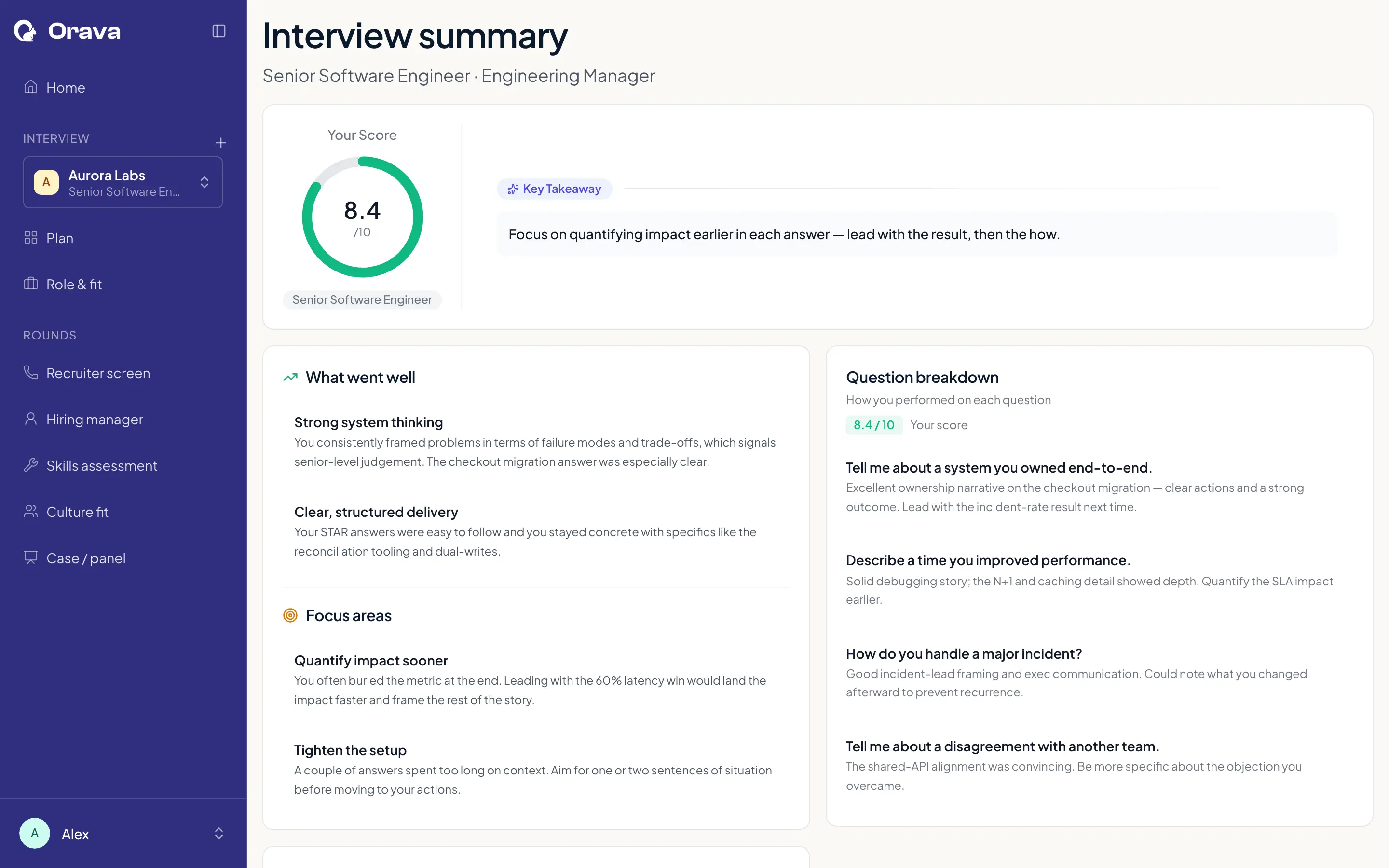
How to Prepare for Software Engineer Interviews
- Master the core data structures and algorithms that appear repeatedly: arrays, hash maps, trees, graphs, heaps, and dynamic programming. These form the backbone of most coding rounds at top companies.
- Practice system design using the RESHADED framework: Requirements → Estimation → Storage → High-level design → APIs → Data flow → Evaluation → Deep dives. Practicing structure matters as much as technical knowledge.
- For behavioral rounds, prepare 6–8 strong STAR stories that can flex across multiple question types. Each story should show a specific result with measurable impact.
- Code out loud. Interviewers evaluate your thought process, not just your final solution. Narrate your approach, state assumptions, and discuss trade-offs before writing a single line.
- Know your time and space complexity for every solution you write. Being able to say "this is O(n log n) time and O(n) space because..." is expected — not optional.
- Research the company's tech stack and engineering blog before your interview. Aligning your system design answers to their known scale (e.g. Google's 8B+ queries/day, Meta's social graph) signals genuine interest.
- Mock interview with a peer or use AI-powered tools to practice speaking your answers under time pressure. Reading solutions is not the same as producing them under interview conditions.
- On the day: ask clarifying questions before starting any problem. Rushing in without understanding constraints is the most common mistake — interviewers respect candidates who slow down to think.
Software Engineer Interview — Frequently Asked Questions
Most software engineer interview processes at top tech companies follow a similar structure: (1) a recruiter screening call (15–30 min), (2) a technical phone or video screen with 1–2 coding problems (45–60 min), and (3) an on-site or virtual final round with 4–6 interviews covering coding, system design, and behavioral questions. The whole process typically takes 2–6 weeks. Some companies like Stripe and Atlassian substitute take-home projects for live coding at the screening stage.
At most mid-to-large tech companies, expect 5–7 total interactions: 1 recruiter screen + 1–2 technical screens + 3–5 final round panels. FAANG companies (Google, Meta, Amazon, Apple, Netflix) tend to run 4–6 final-round interviews in a single loop. Startups and scale-ups typically run 3–5 interviews total. Always ask your recruiter for the exact breakdown early in the process.
Entry-level (L3/SWE-I) interviews focus on coding proficiency, understanding of core data structures and algorithms, and basic debugging skills. Senior (L5/L6) interviews add a system design round (1–2 interviews on designing scalable distributed systems), a leadership/behavioral round assessing cross-team influence, and deeper product and architectural thinking. At the senior level, interviewers assess how you make decisions, not just whether you can code. The coding problems also tend to be harder and the bar for complexity analysis is higher.
Use the language you know best — interviewers care about clear, correct, working code, not the language choice. Python is the most popular for coding interviews due to its concise syntax and built-in data structures. Java and C++ are also widely accepted. JavaScript is fine if you're interviewing at a front-end or full-stack focused company. Avoid esoteric or unfamiliar languages. If a company has a preference, your recruiter will mention it.
For a first FAANG or top-tier tech interview: plan for 8–12 weeks of focused preparation (1–2 hours per day). This is enough time to cover core algorithms and data structures, complete 100–150 LeetCode problems across easy/medium/hard, and practice 8–10 system design problems. If you have prior experience with technical interviews or a strong CS background, 4–6 weeks of targeted review may suffice. The key is consistency over intensity — spaced practice beats cramming.
No. Top tech companies including Google, Apple, and Meta have explicitly removed degree requirements. What matters is demonstrating the knowledge typically acquired through a CS degree: data structures, algorithms, system design, and software engineering fundamentals. Many successful engineers at FAANG are self-taught or bootcamp graduates. That said, you'll need to cover the same material on your own — focus on algorithms (sorting, searching, graph traversal), data structures (trees, heaps, hash maps), and object-oriented or functional design principles.
Google places heavy emphasis on algorithmic problem-solving (often harder than LeetCode Hard difficulty) and system design at Google scale (billions of users). Their interviews have a strict rubric and the bar for clarity of reasoning is very high. Meta (formerly Facebook) tends to ask more product-oriented system design questions and places strong weight on behavioral interviews aligned to their core values. Meta coding rounds are typically LeetCode Medium difficulty. Both are rigorous, but Google skews more algorithmic while Meta balances product thinking and engineering. See the Google Software Engineer and Meta Software Engineer guides for company-specific prep.
Total compensation for software engineers varies significantly by company and level, and is typically base salary plus stock (RSUs) and bonus. Pay varies by level, location and team. Many postings list a base-pay range (US postings in states such as California and New York are required to), so check the posting for your role and ask your recruiter how equity and any bonus work at your level. Always negotiate — the first offer is rarely the final one.
Core topics: horizontal vs vertical scaling, load balancing, database sharding and replication, SQL vs NoSQL trade-offs, caching strategies (CDN, Redis, in-memory), message queues (Kafka, SQS), API design (REST, GraphQL, gRPC), CAP theorem and consistency models, and microservices vs monolith trade-offs. Practice designing real systems: URL shortener, ride-sharing app, social media feed, search autocomplete, video streaming platform. Aim to practice 1–2 system design problems per week in the run-up to interviews.
Applying for this role?
Paste the Software Engineer posting and your resume. See which requirements your resume already proves, and which answers to prepare first.
Compare my resume to this roleFree · no account needed