
Netflix Analytics Engineer Interview Questions & Process (2026)
4 min read11 practice questionsUpdated Sep 29, 2026
Analytics Engineer interviews test how you reason through a technical problem out loud: the approach you pick, the trade-offs you name and how you check your work. This guide gives cultural fit, behavioral, technical, system design and case study practice questions for the Netflix loop, with notes on how to answer them.
Hear how your answer lands before the interview
“Tell me about a time you discovered and resolved a significant data quality issue that was affecting business decisions.”
Rehearse my answerFree · no account needed
Sample Netflix Analytics Engineer Interview Questions
Cultural Fit Questions
1 question- 1
Netflix's culture values freedom and responsibility — how would you approach owning the quality and reliability of a business-critical data mart with full autonomy and no direct oversight?
How to answer: Show self-directed ownership: proactive monitoring, SLAs you'd define, how you'd communicate data issues, and how you'd build trust with stakeholders without hand-holding.
“Tell me about yourself”, “Why here?” and the other common questions, and how to prep each →
Behavioral Questions
3 questions- 1
Tell me about a time you discovered and resolved a significant data quality issue that was affecting business decisions.
How to answer: Use STAR method. Emphasize how you identified the issue (was it reported or did you catch it proactively?), the downstream impact, your triage and fix, and the preventative measures you put in place.
- 2
Describe a situation where you had to simplify a complex dataset or metric for a non-technical stakeholder. What was your approach?
How to answer: Show your communication skills and the ability to translate technical complexity into clear business language. Highlight empathy for the stakeholder's actual question, not just the data surface.
- 3
Tell me about a time you improved a data pipeline or model that had high technical debt. How did you approach the refactor?
How to answer: Discuss how you assessed scope and risk, planned the migration, maintained backwards compatibility, and communicated the change to downstream users.
The six topics behind behavioral questions, and how to prep a story for each →
Technical Questions
3 questions- 1
Write a SQL query to find the top 10 titles by average watch time per user session in the past 30 days, excluding sessions under 2 minutes.
How to answer: Demonstrate window functions or aggregations, proper date filtering, handling of NULL values, and clear aliasing. Think about query efficiency for a large events table.
- 2
How would you implement a dbt project structure for a large Netflix analytics domain with 50+ models and multiple downstream teams?
How to answer: Discuss project structure (sources, staging, intermediate, marts), ownership by domain, tagging, dbt tests (schema tests + custom tests), freshness SLAs, and CI/CD with dbt Cloud or dbt Core on Airflow.
- 3
Netflix has a 'normalised' and a 'personalized' view of content popularity. How would you model both in a warehouse to enable consistent reporting across business units?
How to answer: Discuss building separate metric definitions in a metrics layer, documenting business logic explicitly in dbt docs, and creating views that expose both normalised and raw counts with clear naming conventions.
System Design Questions
3 questions- 1
Design a data model to support Netflix's content performance analytics — tracking engagement, completion rate, and viewership trends across titles, regions, and device types.
How to answer: Propose a layered dbt model: staging from raw events → intermediate aggregations → reporting mart. Design dimensions (title, region, device, date) and facts (viewing events, completion events). Discuss grain, slowly-changing dimensions, and how you'd handle late-arriving data.
- 2
How would you design the data infrastructure to support Netflix's A/B experimentation platform — tracking experiment assignments, exposures, and downstream metric impacts?
How to answer: Cover experiment assignment logging, exposure deduplication, metric pre-computation, CUPED variance reduction pipeline, and how you'd make experiment results queryable in a self-serve analytics tool.
- 3
How would you build a data quality monitoring framework for Netflix's member activity data lake?
How to answer: Cover row count validation, null rate checks, referential integrity, distribution drift detection, freshness SLAs, and how you'd alert on failures without creating alert fatigue.
System design questions grouped by the concept they test, with a full walkthrough →
Case Study Questions
1 question- 1
A key business stakeholder says the engagement metric you own is 'wrong' because it doesn't match a number they saw in a dashboard last quarter. How do you handle this?
How to answer: Show data debugging skills — reproduce the discrepancy, identify whether it's a logic change, a data pipeline issue, or a different definition. Prioritize transparent communication throughout and build a path to resolution.
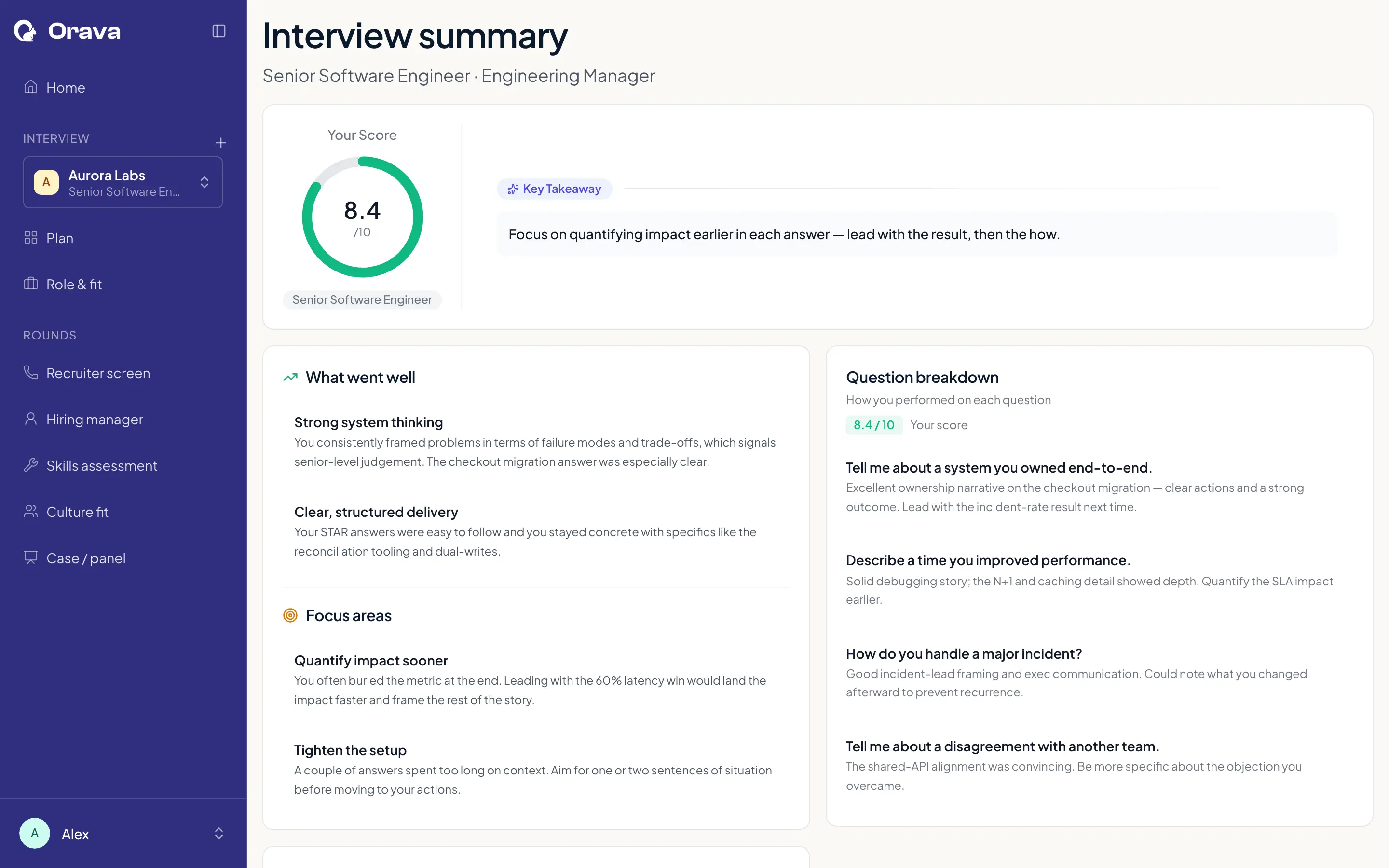
Rehearse this one out loud:
“Tell me about a time you discovered and resolved a significant data quality issue that was affecting business decisions.”
Preparation Tips for Netflix Analytics Engineer Interviews
- Study advanced SQL thoroughly — window functions, CTEs, query optimization, and complex aggregations are central to the role
- Learn dbt deeply: modular project structure, testing strategies, documentation, freshness tests, and CI/CD workflows
- Read Netflix's engineering and data blog to understand their experimentation culture, data platforms (Iceberg, Spark, Flink), and metric philosophy
- Prepare concrete examples of improving data reliability or reducing time-to-insight for business stakeholders
- Understand Netflix's high-performance culture — demonstrate that you can operate with autonomy, make decisions with incomplete information, and communicate with clarity
- Be ready to defend your data modeling choices — grain decisions, dimensional vs one-big-table trade-offs, and handling of slowly-changing dimensions
Frequently Asked Questions - Netflix Analytics Engineer
The Netflix Analytics Engineer process typically includes 5-6 rounds: a recruiter screen (30 min), a hiring manager conversation (45 min), a technical SQL/data modeling interview (60 min), a systems thinking and analytics architecture round (60 min), a cross-functional collaboration interview (45 min), and a final leadership principles round. Netflix looks for strong analytical rigor, the ability to own data infrastructure end-to-end, and alignment with their high-performance culture.
Core requirements: advanced SQL, dbt (data build tool) for modeling and transformation, experience with cloud data warehouses (Snowflake, BigQuery, or Redshift), Python for data processing, and strong data modeling fundamentals (dimensional, Kimball, or OBT approaches). Experience with Spark for large-scale data processing, experimentation platform infrastructure (A/B testing pipelines), and data quality frameworks (Great Expectations, Monte Carlo) are highly valued.
Practice advanced SQL: window functions, CTEs, query optimization, and complex aggregations. Be ready to design a data model from scratch given business requirements. Study dbt best practices — modular staging/intermediate/mart layers, testing strategies (unique, not_null, custom schema tests), and documentation. Netflix loves questions about how you've improved data reliability and reduced time-to-insight for stakeholders. Understand Netflix's culture of high autonomy and context-over-control — be ready to explain architectural decisions clearly.
Pay varies by level, location and team. Many postings list a base-pay range (US postings in states such as California and New York are required to), so check the posting for your role and ask your recruiter how equity and any bonus work at your level.
At Netflix, Analytics Engineers sit at the intersection of data engineering and analytics. They own the transformation layer — turning raw, complex data into clean, trusted, documented data models that analysts and scientists can self-serve from. Unlike Data Engineers who focus on ingestion and pipeline infrastructure, Analytics Engineers focus on semantic layer design, metric definitions, and data quality. Unlike Analysts who consume data, AEs build the infrastructure that enables fast, trustworthy analysis at scale.
Applying for this role?
Paste the Netflix posting and your resume. See which requirements your resume already proves, and which answers to prepare first.
Compare my resume to this roleFree · no account needed