Engineering Manager Interview Questions & Topics (2026)
5 min read20 practice questionsUpdated Sep 29, 2026
Engineering manager interviews are a different beast from individual contributor interviews. The technical bar remains high — you'll face system design and architectural questions — but the primary assessment is leadership: how you develop engineers, drive delivery, resolve conflict, and build culture. Topics covered in 2026 EM interviews span people management, technical leadership, delivery and execution, cross-functional collaboration, and hiring — with companies like Google, Meta, Anthropic, and OpenAI weighting each differently. This guide covers the questions and frameworks that matter most, from your management philosophy to handling underperformers.
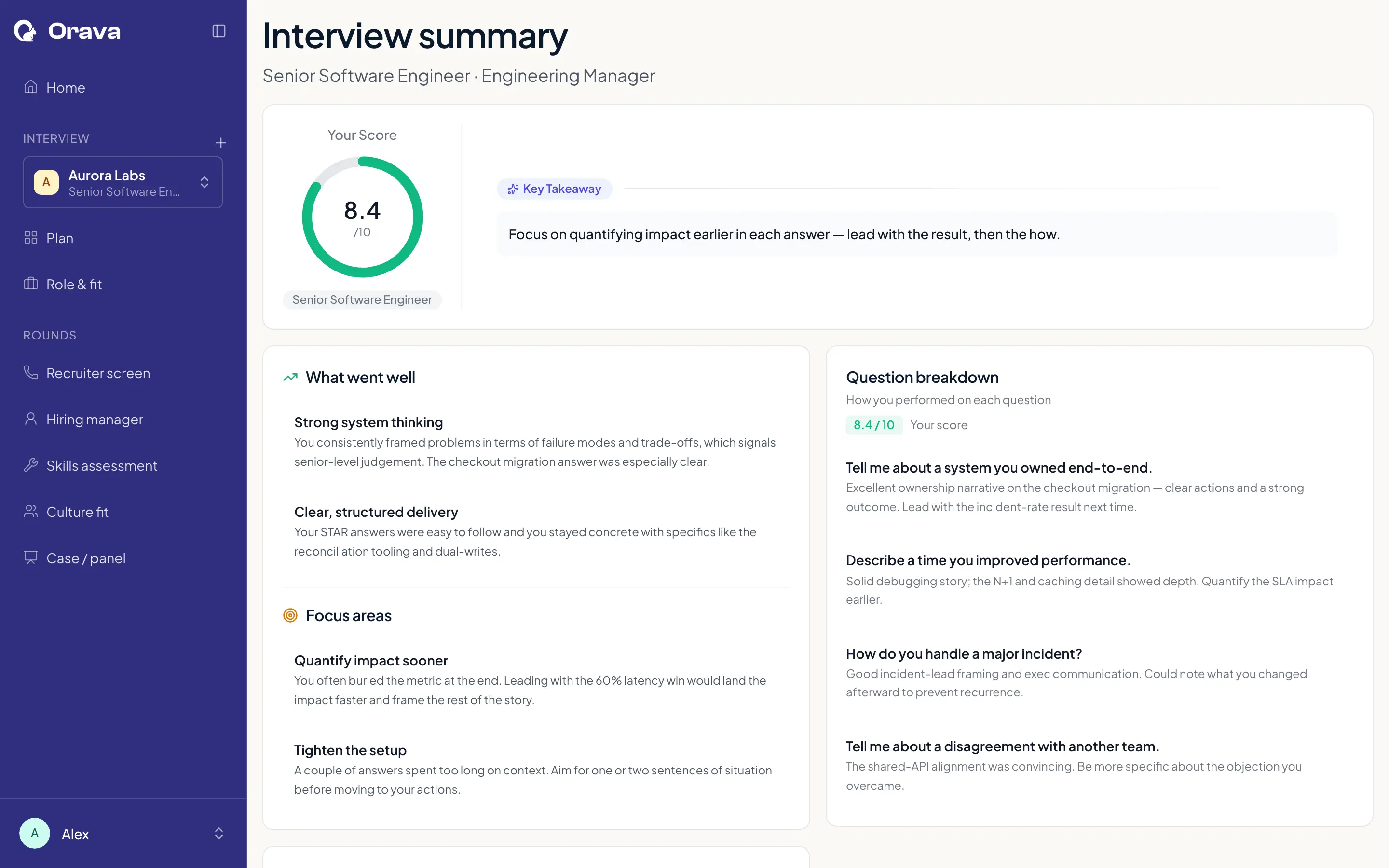
Hear how your answer lands before the interview
“How do you handle a situation where product management keeps changing priorities mid-sprint?”
Rehearse my answerFree · no account needed
Engineering Manager Interview Questions
Cultural Fit Questions
1 question- 1
What is your management philosophy in one sentence, and where did it come from?
Entry-levelHow to answer: Have a genuine, considered answer — not a platitude. The best answers are specific to your experience and show how your philosophy has evolved through real situations. Interviewers are checking for self-awareness and intentionality.
“Tell me about yourself”, “Why here?” and the other common questions, and how to prep each →
Behavioral Questions
4 questions- 1
How do you handle a situation where product management keeps changing priorities mid-sprint?
Mid-levelHow to answer: Demonstrate collaborative problem-solving: clarify the root cause (unclear strategy, reactive culture, insufficient discovery), propose solutions (a change-request process, better sprint planning, a product-engineering alignment cadence), and advocate for your team's focus without being adversarial.
- 2
Tell me about the team culture you are most proud of building.
SeniorHow to answer: Be specific about what you deliberately created — not what happened by luck. Describe the practices you introduced, the behaviors you reinforced, and how you measured whether the culture was working. Mention things that were hard to change and how you navigated resistance.
- 3
Describe a time you had to make a decision your team disagreed with.
Mid-levelHow to answer: Show you can lead through disagreement: you listened, you explained your reasoning, you were transparent about the trade-offs, and you created space for dissent without losing decisiveness. Share what happened and whether the outcome validated or changed your thinking.
- 4
Tell me about a time you failed as a manager. What did you learn?
SeniorHow to answer: Intellectual honesty about failure is a strong signal in EM interviews. Be specific: what went wrong, what you missed, what you would do differently, and how you changed your approach afterwards. Vague or blame-shifted answers are a red flag.
The six topics behind behavioral questions, and how to prep a story for each →
Technical Questions
1 question- 1
How do you approach technical debt on your team?
Mid-levelHow to answer: Show nuanced thinking: not all tech debt is bad, and not all of it should be paid down immediately. Discuss how you quantify debt (impact on velocity, reliability, developer experience), advocate for dedicated time in planning, and make debt visible to non-technical stakeholders.
Case Study Questions
1 question- 1
A critical project is three weeks behind schedule. How do you respond?
SeniorHow to answer: Structured response: diagnose the root cause before acting, assess whether the deadline is fixed or flexible, identify what can be descoped without compromising core value, communicate transparently to stakeholders, and put a recovery plan in place. Show calm escalation over panic.
Leadership Questions
13 questions- 1
Tell me about a time you had to have a difficult conversation with an underperforming engineer.
Mid-levelHow to answer: Show empathy, directness, and a structured approach: early identification of the issue, clear and specific feedback, a defined improvement plan, and consistent follow-through. Avoid vague generalities — interviewers want to know you have done this, not just that you would.
- 2
How do you onboard a new engineer to maximize their productivity and integration with the team?
Mid-levelHow to answer: Cover: pre-day-one preparation (access, equipment, buddy pairing), structured first 30/60/90 day plans, starter tasks calibrated to build confidence, regular 1:1s, and explicit team norms documentation. Show you have a system, not just good intentions.
- 3
One of your best engineers is considering leaving. How do you handle it?
SeniorHow to answer: Show proactive retention thinking: understanding their motivations through regular 1:1s, career growth mapping, and addressing issues before they become exits. Discuss the balance between retaining talent and accepting that some moves are right for the individual.
- 4
How do you manage performance across a team with very different skill levels?
SeniorHow to answer: Discuss: individual development plans, calibrated expectations per level, pairing junior and senior engineers intentionally, code review as a teaching tool, and protecting senior engineers' time for high-leverage work while growing junior engineers' scope.
- 5
Describe your approach to building psychological safety on an engineering team.
SeniorHow to answer: Reference Amy Edmondson's research if you know it. Concrete practices: blameless post-mortems, visibly praising questions and admissions of uncertainty, addressing dismissive behavior immediately in code reviews, modeling vulnerability as a leader.
- 6
How do you stay technically credible as an engineering manager without being an individual contributor?
SeniorHow to answer: Discuss: staying in the code review loop, understanding architectural decisions deeply enough to ask the right questions, attending technical design reviews, and maintaining your own side projects. The goal is "T-shaped" — enough depth to evaluate trade-offs, enough breadth to not bottleneck the team.
- 7
Walk me through how you would architect a technical interview process for your team.
SeniorHow to answer: Cover: consistency (same rubric for every candidate), reducing bias (structured questions, multiple interviewers, calibration sessions), testing for real skills (not brain teasers), and candidate experience. Great EMs see recruiting as a product with a customer (the candidate).
- 8
How do you improve team velocity without burning out your engineers?
SeniorHow to answer: Velocity is a means, not an end. Discuss: removing process blockers (meeting load, unclear requirements, poor tooling), investing in automation and CI/CD, improving estimation accuracy, and protecting engineers' deep work time. Burnout prevention: sustainable pace, explicit WIP limits, and rotating on-call.
- 9
How do you balance feature delivery with reliability and operational excellence?
SeniorHow to answer: Show you think about this proactively: error budgets and SLOs (SRE model), embedding reliability work in team OKRs, making operational metrics visible alongside delivery metrics, and celebrating engineering excellence, not just shipping speed.
- 10
How do you communicate engineering progress and risks to non-technical executives?
SeniorHow to answer: Translate technical signals to business outcomes: rather than "we have 300 open tickets", say "our current technical debt is increasing our mean time to resolve customer-facing incidents by 40%". Discuss your cadence, format (weekly update, OKR dashboards), and how you handle bad news.
- 11
How do you evaluate whether to hire a generalist or specialist for an open role?
SeniorHow to answer: Discuss: current team gaps, growth trajectory of the product, stage of the company (early-stage: generalists; scaling: specialists), and the cost of training vs time-to-productivity. Show you think about team composition as an architecture problem.
- 12
How do you think about team structure — should you organize by function, product area, or something else?
SeniorHow to answer: Reference Conway's Law: your team structure will shape your system architecture. Discuss the trade-offs between functional (economies of scale, siloed delivery) and cross-functional "two-pizza teams" (autonomy, end-to-end ownership). Show you have a view grounded in the company's specific context.
- 13
How do you support engineers in their career growth beyond your team?
SeniorHow to answer: Great EMs develop people who outgrow them. Discuss: active internal networking, advocating for promotions and stretch assignments, sponsoring engineers for talks or publications, and being genuinely delighted when they move to bigger opportunities.
The leadership topics EM interviewers probe, with worked answers →
Rehearse this one out loud:
“How do you handle a situation where product management keeps changing priorities mid-sprint?”
How to Prepare for Engineering Manager Interviews
- The EM interview is primarily a leadership interview. Have 8–10 specific stories from your experience ready — covering people development, conflict resolution, delivery under pressure, and technical credibility. Vague answers ("I would always try to...") are a red flag.
- Be ready to discuss your management philosophy with specificity and self-awareness. Companies like Anthropic, Google, and Meta explicitly assess whether your style fits their engineering culture. Know what you believe and why.
- Quantify your impact wherever possible. "I improved team velocity" is weak; "I reduced sprint carryover from 30% to 8% by introducing a scope lock 48 hours before sprint start" is compelling. Numbers matter even in a people-focused role.
- Show you understand the technical dimension. EMs who can read a system design, spot a concerning architecture decision, or ask the right question in a code review earn far more trust from their teams than those who operate purely on process.
- Prepare for the "difficult conversation" question — it comes up at nearly every company. Have a specific, recent example where you gave hard feedback to an engineer, and be prepared to explain the outcome in detail, including what you learned.
- Understand the company's engineering principles before your interview. Google, Meta, Anthropic, OpenAI, and Shopify each have distinct engineering cultures. Demonstrating you understand what they value — and how your style aligns — is a strong differentiator.
- Think carefully about the transition from IC to EM if you are recently promoted. Interviewers will probe whether you have genuinely shifted your identity from "best coder" to "best multiplier of the team". Be honest about what was hard about the shift.
Engineering Manager Interview — Frequently Asked Questions
EM interview processes typically span 5–7 stages: (1) recruiter screen (background and motivation, 30 min), (2) hiring manager conversation (leadership philosophy and experience, 45–60 min), (3) technical interview (system design or architectural review, 45–60 min), (4) people management panel (behavioral scenarios with an HR partner or senior EM, 45–60 min), (5) cross-functional interview (working with product and design, 45 min), and often (6) a panel or presentation round with senior leadership. The full process takes 4–8 weeks at most top companies.
It depends on the company. At Google and Meta, EM interviews include a technical component — usually a system design interview rather than live coding, though some companies do include a coding screen. At Anthropic and OpenAI, technical depth is heavily weighted. At other companies, the technical bar for EMs is lighter and focused more on architectural reasoning. Always ask your recruiter what to expect. Regardless, you should be comfortable whiteboarding a system design and discussing trade-offs in code reviews.
A Technical Lead (TL) remains an Individual Contributor who is responsible for the technical direction and quality of a project or team. An Engineering Manager has people management responsibilities: hiring, performance reviews, career development, team health, and cross-functional coordination. Some companies have a "TLM" (Tech Lead Manager) role that combines both. EMs typically stop coding full-time; TLs remain hands-on in the codebase. For most EM roles, your primary leverage shifts from writing code to multiplying others' impact.
Google EM interviews place significant weight on technical rigor — you're expected to handle a system design interview at the same standard as a senior SWE, plus leadership and people management rounds. Google also assesses against their values (Googleyness) explicitly. Meta EM interviews focus heavily on people management and cross-functional execution, with behavioral questions structured around their core values. Meta's technical bar for EMs is high but often framed around architectural review rather than hands-on coding. See the Meta Engineering Manager and Anthropic Engineering Manager guides for company-specific prep.
EM compensation varies significantly by company, team size, and scope. Pay varies by level, location and team. Many postings list a base-pay range (US postings in states such as California and New York are required to), so check the posting for your role and ask your recruiter how equity and any bonus work at your level.
The most common path: take on informal leadership responsibilities as a senior IC (mentoring, leading a project, running a hiring loop), make your interest known to your manager, then step into an EM role internally before interviewing externally. For external applications, you typically need at least 2–3 years as an IC plus some demonstrated leadership experience (team lead, tech lead, or interim EM). The hardest part of the transition is psychological: accepting that your output is measured through your team's results, not your personal code. The best preparation is honest conversations with current EMs about the day-to-day reality of the role.
For a senior EM role at a top company: plan for 6–8 weeks of preparation. Week 1–2: Refresh your system design knowledge (distributed systems, scalability patterns). Week 3–4: Prepare and rehearse 8–10 STAR leadership stories covering people management, delivery, conflict, and culture-building. Week 5–6: Research the company's engineering culture and leadership principles in depth. Week 7–8: Mock interviews focusing on both the technical component and leadership scenarios. The key is practicing out loud — leadership stories in particular need to be concise, specific, and delivered without reading notes.
Applying for this role?
Paste the Engineering Manager posting and your resume. See which requirements your resume already proves, and which answers to prepare first.
Compare my resume to this roleFree · no account needed