OpenAI Engineering Manager Interview Questions & Process (2026)
4 min read11 practice questionsUpdated Sep 29, 2026
Engineering Manager interviews test how you grow people, run delivery and make technical calls through a team. This guide gives cultural fit, behavioral, technical, case study and leadership practice questions for the OpenAI loop, with notes on how to answer them.
Hear how your answer lands before the interview
“Tell me about a time you built and retained a high-performing engineering team in a fast-changing, ambiguous environment.”
Rehearse my answerFree · no account needed
Sample OpenAI Engineering Manager Interview Questions
Cultural Fit Questions
1 question- 1
OpenAI's mission is to ensure that AGI benefits all of humanity — how do you think about your role as an Engineering Manager in advancing both capability and safety goals simultaneously?
How to answer: Show genuine engagement with the dual mandate. Discuss how you'd build engineering practices that accelerate capability research without cutting corners on safety — red-teaming, staged rollouts, monitoring, responsible disclosure.
“Tell me about yourself”, “Why here?” and the other common questions, and how to prep each →
Behavioral Questions
3 questions- 1
Tell me about a time you built and retained a high-performing engineering team in a fast-changing, ambiguous environment.
How to answer: Use STAR method. Highlight your recruiting strategy, how you created psychological safety, navigated performance issues, and maintained team cohesion through organizational change or rapid growth.
- 2
Describe a situation where you had to make a difficult engineering trade-off decision under time pressure. How did you make the call and what was the outcome?
How to answer: Show decision-making under uncertainty: how you gathered information quickly, communicated trade-offs clearly, built alignment, and took ownership of the outcome — including if it didn't go as planned.
- 3
Tell me about a time you had to restructure a team or change how it worked. What drove the change and how did you manage it?
How to answer: Demonstrate change management skills: diagnosing the root cause, transparent communication, managing individual concerns, and measuring whether the change achieved its goal.
The six topics behind behavioral questions, and how to prep a story for each →
Technical Questions
1 question- 1
How would you approach building out a technical roadmap for a team working on model fine-tuning and deployment infrastructure?
How to answer: Discuss discovery process (bottom-up input + top-down strategy), how you'd sequence work by impact and risk, handle dependencies on research teams, and communicate progress to leadership.
Case Study Questions
1 question- 1
Your team is behind on a critical safety release. Leadership is pushing for a faster timeline, but your engineers have identified unresolved risks. How do you navigate this?
How to answer: Demonstrate the ability to hold firm on safety standards under pressure. Show how you'd escalate the risk clearly to leadership, propose mitigation options, and advocate for your team's assessment while being collaborative rather than adversarial.
Leadership Questions
5 questions- 1
How would you structure and scale an engineering team responsible for OpenAI's API infrastructure to handle 10x traffic growth while maintaining safety guarantees?
How to answer: Cover team structure (on-call, platform vs product split), technical architecture (autoscaling, rate limiting, safety filters), hiring plan, operational excellence practices, and how you'd maintain safety invariants at higher traffic.
- 2
Design an engineering organization for a new OpenAI product team launching a safety-critical AI feature — from initial team setup to production launch.
How to answer: Discuss team composition (infra, applied ML, safety, product engineering), milestone cadence, safety review gates, stakeholder communication, and post-launch monitoring plan.
- 3
A senior engineer on your team is delivering excellent technical work but creating friction with peers. How do you handle it?
How to answer: Show nuance: differentiate between productive disagreement and destructive behavior. Describe a direct, private conversation, setting clear behavioral expectations, and monitoring for change — while also examining whether the team environment is contributing.
- 4
How would you implement engineering practices to ensure responsible AI behavior is maintained as your team scales from 10 to 50 engineers?
How to answer: Discuss onboarding for safety culture, code review requirements for safety-sensitive changes, internal red-teaming practices, runbook standards, and how to preserve institutional knowledge as the team grows.
- 5
How would you measure engineering team health and productivity in a way that doesn't sacrifice quality or psychological safety?
How to answer: Discuss DORA metrics (deployment frequency, lead time, MTTR, change failure rate) alongside qualitative signals (engagement surveys, 1:1 quality, retention) — and how you'd use both to inform management decisions rather than purely metric-drive behavior.
The leadership topics EM interviewers probe, with worked answers →
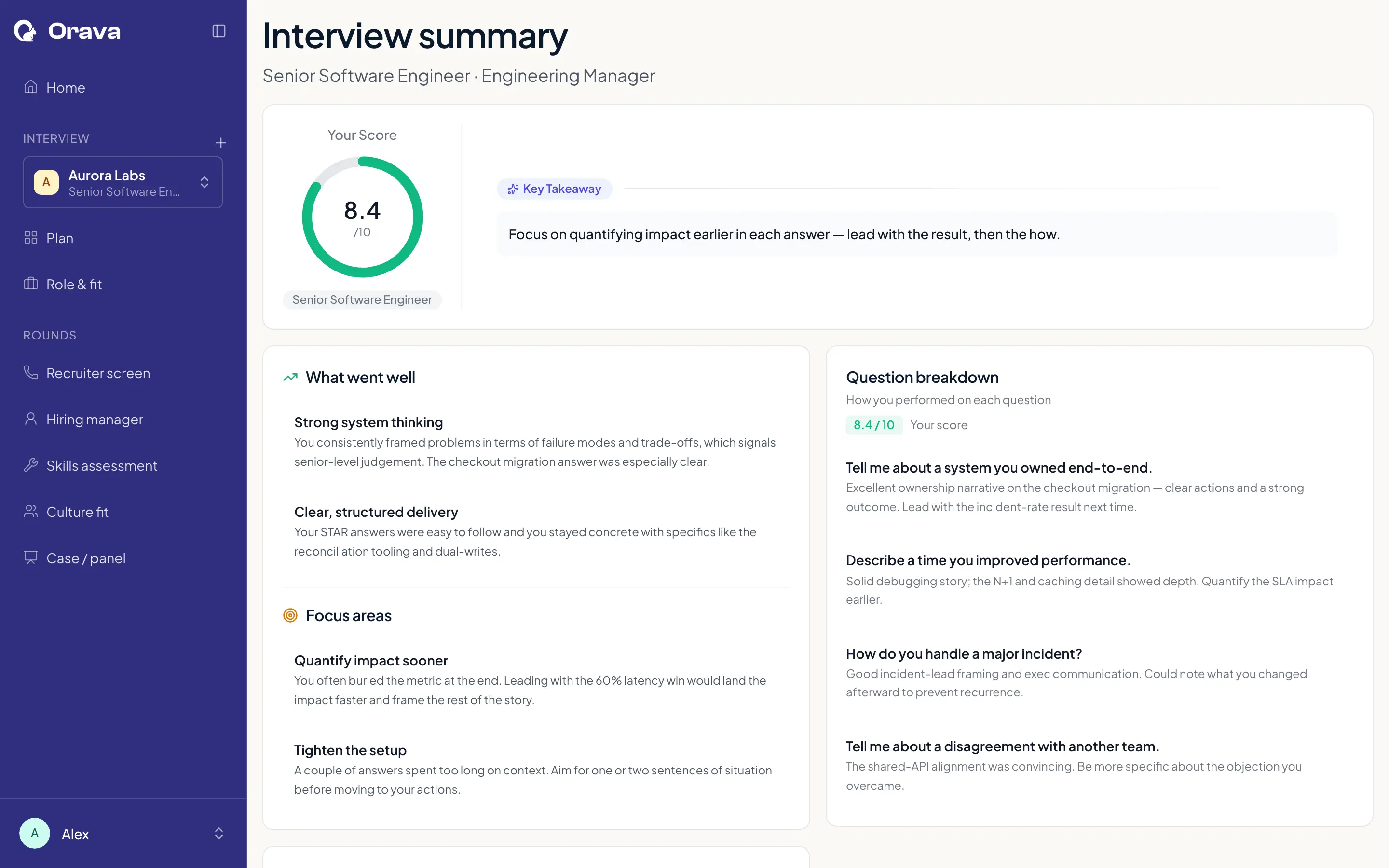
Rehearse this one out loud:
“Tell me about a time you built and retained a high-performing engineering team in a fast-changing, ambiguous environment.”
Preparation Tips for OpenAI Engineering Manager Interviews
- Study OpenAI's research output and product portfolio (ChatGPT, API, Sora, Codex) to demonstrate genuine mission engagement
- Prepare leadership stories that show both technical depth and people management maturity — OpenAI values technical EMs who can earn respect from world-class researchers
- Read OpenAI's usage policies and safety documentation to understand how they operationalise responsible deployment
- Practice discussing how you balance speed and safety under competitive pressure — this is a core OpenAI leadership challenge
- Be ready to discuss team structure for AI product teams: the EM role often bridges applied ML, infrastructure, and product engineering
- Demonstrate comfort with high ambiguity and rapid change — OpenAI moves extremely fast and values EMs who thrive in this environment
- Prepare specific examples of recruiting and retaining top engineering talent in a highly competitive market
Frequently Asked Questions - OpenAI Engineering Manager
The OpenAI EM interview process typically includes 5-6 rounds: a recruiter screen (30 min), a hiring manager conversation on leadership philosophy and experience (45 min), a technical leadership and architecture discussion (60 min), a people management and team-building round (45 min), a safety and values alignment interview (45 min), and a final leadership loop with senior stakeholders. The process tests both engineering depth and leadership breadth, with strong emphasis on mission alignment.
OpenAI seeks EMs with proven experience leading high-performing engineering teams, ideally in AI/ML infrastructure, applied AI products, or large-scale distributed systems. Key areas: building and retaining top talent, driving technical direction with safety in mind, navigating the tension between fast iteration and responsible deployment, cross-functional collaboration with research and product, and creating inclusive engineering cultures. Mission alignment to AGI safety is critically evaluated.
Prepare leadership examples that demonstrate both technical excellence and safety awareness. Study OpenAI's research (GPT series, Codex, DALL-E, safety papers) and be ready to discuss how infrastructure and engineering decisions connect to the company's mission. Be prepared to discuss how you've handled the pace and ambiguity of working on frontier AI systems. Understand OpenAI's dual mission — advancing AI capability and ensuring it benefits humanity — and how you'd operationalise this tension as an EM.
Pay varies by level, location and team. Many postings list a base-pay range (US postings in states such as California and New York are required to), so check the posting for your role and ask your recruiter how equity and any bonus work at your level.
Standout candidates demonstrate the ability to build and lead world-class engineering teams on frontier AI challenges, deep technical fluency that earns the respect of top researchers and engineers, a track record of shipping responsibly under pressure, and genuine alignment with OpenAI's mission to develop safe, beneficial AGI. They show curiosity about AI safety, comfort with novel and ambiguous problems, and the leadership maturity to navigate a fast-moving, high-stakes environment.
Applying for this role?
Paste the OpenAI posting and your resume. See which requirements your resume already proves, and which answers to prepare first.
Compare my resume to this roleFree · no account needed