
Uber Engineering Manager Interview Questions & Process (2026)
4 min read10 practice questionsUpdated Sep 29, 2026
Engineering Manager interviews test how you grow people, run delivery and make technical calls through a team. This guide gives cultural fit, behavioral, technical, system design and leadership practice questions for the Uber loop, with notes on how to answer them.
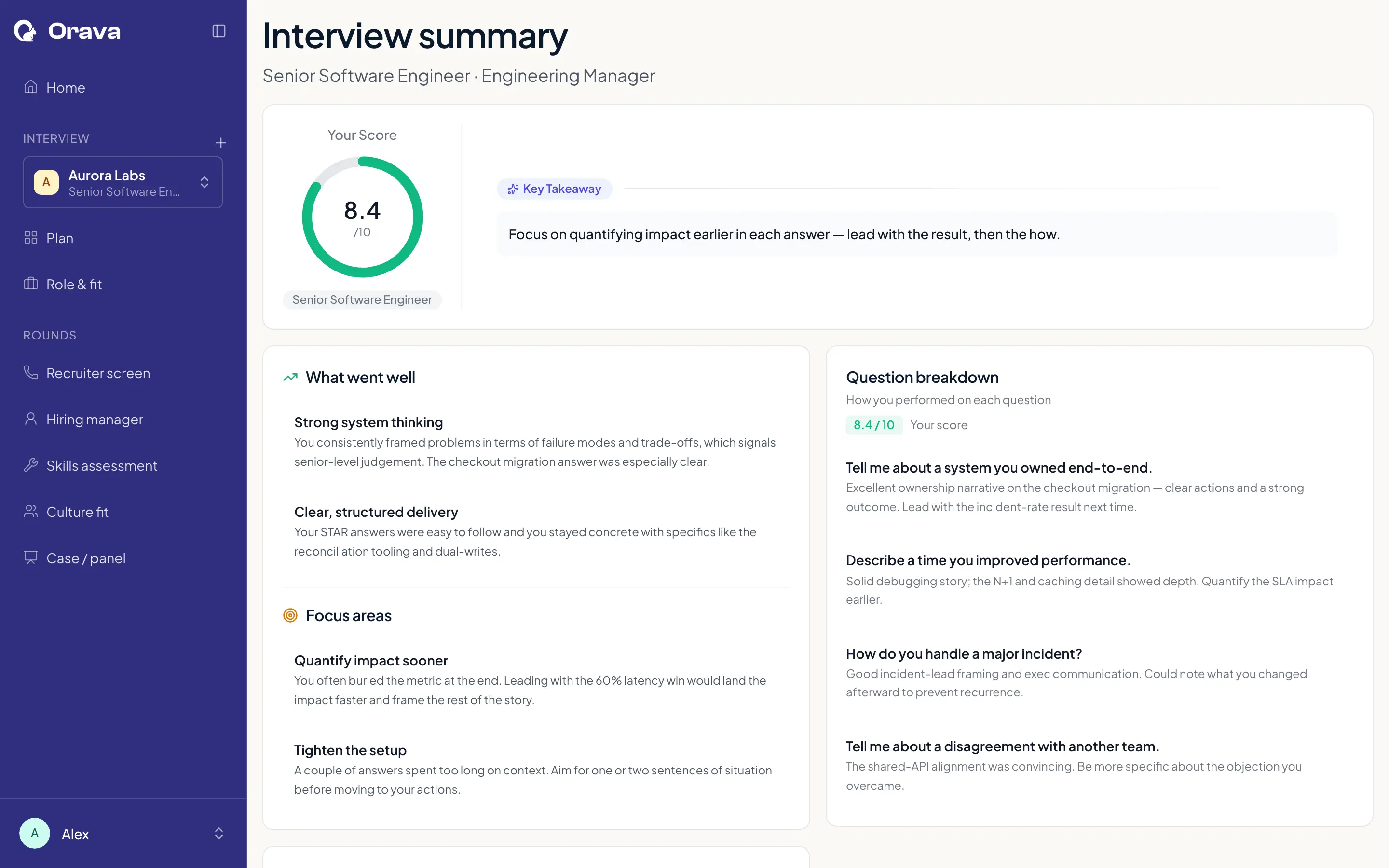
Hear how your answer lands before the interview
“Tell me about a time you inherited an underperforming engineering team. How did you diagnose the issues and turn things around?”
Rehearse my answerFree · no account needed
Sample Uber Engineering Manager Interview Questions
Cultural Fit Questions
1 question- 1
Uber operates across Mobility, Delivery, and Freight — each with different technical and business challenges. How do you adapt your engineering leadership style to different business contexts?
SeniorHow to answer: Show adaptability: discuss how you'd lead differently for a latency-sensitive ride-hailing team vs. a logistics optimization team. Demonstrate understanding that 'good engineering' looks different depending on the problem domain and business maturity.
“Tell me about yourself”, “Why here?” and the other common questions, and how to prep each →
Behavioral Questions
4 questions- 1
Tell me about a time you inherited an underperforming engineering team. How did you diagnose the issues and turn things around?
SeniorHow to answer: Use STAR method. Show diagnostic thinking: was it a people problem, process problem, or technical debt problem? Describe specific actions — 1:1s, retros, hiring changes, tech debt sprints — and quantify the improvement. Uber values EMs who can diagnose and act quickly.
- 2
Describe a situation where you had to make a difficult trade-off between shipping speed and engineering quality. What did you decide and why?
Mid-levelHow to answer: Show nuanced thinking: blanket answers like 'I always prioritize quality' won't work at Uber's pace. Discuss how you assessed the risk, what guardrails you put in place (feature flags, monitoring, rollback plan), and how you communicated the trade-off to stakeholders.
- 3
Tell me about a time you had to partner with a product manager who had very different priorities from your engineering team. How did you align?
Mid-levelHow to answer: Demonstrate cross-functional leadership: show you understand the PM's perspective (user value, business metrics) and can find alignment without simply deferring. Discuss shared frameworks like RICE scoring or impact-effort matrices.
- 4
Walk me through a time you had to scale your team rapidly while maintaining culture and technical quality.
SeniorHow to answer: Discuss hiring strategy (referral pipeline, bar consistency), onboarding (buddy system, ramp-up projects), and how you preserved team norms. Uber cares about EMs who can grow teams without diluting quality.
The six topics behind behavioral questions, and how to prep a story for each →
Technical Questions
2 questions- 1
Your team's service is experiencing increased latency that's affecting ride-matching times globally. Walk me through your incident response as an EM.
SeniorHow to answer: Show structured incident leadership: triage severity, assemble the right people, communicate to stakeholders, guide debugging without micromanaging engineers, make the call on short-term mitigation vs. proper fix, and drive a blameless post-mortem. Uber runs global systems where incidents have real-world safety impact.
- 2
You need to decompose a monolithic service into microservices while your team continues to ship features. How do you plan and execute this migration?
SeniorHow to answer: Discuss: strangler fig pattern, defining service boundaries (domain-driven design), maintaining backward compatibility during migration, feature flags, rollback strategy, and how you'd staff the work (dedicated migration team vs. rotating ownership). Show you understand the organizational challenge, not just the technical one.
System Design Questions
2 questions- 1
Design a real-time ride dispatch system that matches riders with nearby drivers, optimizing for wait time, driver earnings, and system efficiency.
SeniorHow to answer: Cover: geospatial indexing (H3 hexagons or geohashing), matching algorithms (greedy vs. batch optimization), handling supply-demand imbalance (surge pricing as a signal), latency requirements (<2s for match), and how you'd evolve the system from MVP to global scale.
- 2
How would you architect a payments system that handles transactions across 70+ countries with different currencies, regulations, and payment methods?
SeniorHow to answer: Discuss: payment gateway abstraction, currency conversion and settlement timing, PCI compliance, idempotency for retry safety, fraud detection integration, and regulatory complexity (PSD2, local payment methods). Show awareness of eventual consistency trade-offs in financial systems.
System design questions grouped by the concept they test, with a full walkthrough →
Leadership Questions
1 question- 1
How would you set up engineering metrics and processes to measure your team's health, velocity, and impact?
Mid-levelHow to answer: Go beyond DORA metrics — discuss how you measure business impact (not just story points), team health indicators (retention, engagement surveys, 1:1 signals), and technical health (incident rate, on-call burden, deploy frequency). Uber values EMs who measure what matters.
The leadership topics EM interviewers probe, with worked answers →
Rehearse this one out loud:
“Tell me about a time you inherited an underperforming engineering team. How did you diagnose the issues and turn things around?”
Preparation Tips for Uber Engineering Manager Interviews
- Study Uber's tech stack and architecture: thousands of microservices, Apache Kafka for event streaming, H3 hexagonal grid for geospatial indexing, and extensive use of Go and Java.
- Prepare leadership stories that show operating in ambiguity — Uber's business has pivoted multiple times (rideshare → delivery → freight → advertising) and EMs must adapt quickly.
- Understand Uber's marketplace dynamics: two-sided marketplaces, surge pricing mechanics, and the tension between rider experience and driver earnings — these shape engineering priorities.
- Be ready to discuss incident management at global scale — Uber systems affect real-world transportation and any outage has immediate, visible impact on millions of users.
- Know the difference between managing an infrastructure team vs. a product team at Uber — infrastructure EMs optimize for reliability and performance, product EMs optimize for user impact and experimentation velocity.
- Read Uber's engineering blog (eng.uber.com) for context on their real-time architecture, ML systems, and platform evolution — interviewers appreciate candidates who've done their homework.
- Prepare for the 'Why Uber?' question with genuine specifics — what about Uber's engineering challenges excites you beyond the brand name?
Frequently Asked Questions - Uber Engineering Manager
Uber EM interviews typically include: recruiter screen (30 min), hiring manager conversation covering background and leadership philosophy (45 min), and an onsite loop with 4-5 rounds: (1) Technical architecture and system design — you'll discuss systems at Uber-scale, (2) People management — hiring, coaching, performance management scenarios, (3) Cross-functional execution — how you partner with product, design, and data science, (4) Behavioral — STAR-format stories about impact, conflict resolution, and decision-making, and sometimes (5) a bar raiser or skip-level round for senior EM roles. Both technical depth and people leadership are evaluated equally.
Very technical. Uber EMs are expected to make sound architectural decisions, participate meaningfully in design reviews, and mentor engineers on technical craft. You should be comfortable discussing: real-time systems (dispatch, ETA, surge pricing), microservices at scale (Uber runs thousands of microservices), data pipeline architecture, and mobile platform trade-offs. You won't be writing production code, but you need to earn your team's technical respect and make informed build-vs-buy decisions.
Uber values EMs who demonstrate: ownership mentality (you own the outcome, not just the process), ability to operate in ambiguity (priorities shift, re-orgs happen — you keep your team productive), data-driven decision-making (metrics-first approach to team health and project impact), strong hiring instincts (Uber's growth depends on EMs who can recruit and close top talent), and candid communication (direct feedback culture, no conflict avoidance).
Common Uber system design topics include: real-time dispatch and matching algorithms, surge pricing and dynamic marketplace balancing, ETA prediction and routing at global scale, payment processing across 70+ countries and currencies, driver/rider safety systems, Uber Eats restaurant ranking and delivery time estimation, and fraud detection. Focus on trade-offs between latency, consistency, and availability — Uber systems often need all three.
Pay varies by level, location and team. Many postings list a base-pay range (US postings in states such as California and New York are required to), so check the posting for your role and ask your recruiter how equity and any bonus work at your level.
Applying for this role?
Paste the Uber posting and your resume. See which requirements your resume already proves, and which answers to prepare first.
Compare my resume to this roleFree · no account needed