
Apple iOS Developer Interview Questions (2026)
4 min read10 practice questionsUpdated Oct 12, 2026
Apple's iOS interviews are set by each team, but candidate reports share a shape: a screen with the hiring or engineering manager, a practical coding round, then a virtual onsite of about five interviews. Several candidates report practical work instead of puzzle-style coding: fixing a data race or deadlock in an app, extending an existing app, or solving a real problem in Xcode. Others still had CoderPad rounds. The postings ask for Swift or Objective-C, UIKit or SwiftUI, concurrency, memory management and performance work with Instruments. The ten questions below cover that ground, each with what the interviewer is checking and how to answer.
Hear how your answer lands before the interview
“Tell me about a time you had to debug a complex issue that was affecting users in production”
Rehearse my answerFree · no account needed
At a glance
- Process
- Not published by Apple, and set team by team. Candidates report a manager screen, a practical coding round, then a virtual onsite of about five interviews.
- Format
- Practical rounds in Xcode or on an existing app in some loops; CoderPad in others. One senior candidate had three short behavioral calls of about 30 minutes.
- Pay
- $150,400–$277,600 base for ICT3–ICT4 iOS roles in Cupertino and New York; $184,700–$324,800 for ICT4–ICT5 (checked Oct 12, 2026).
- What it tests
- Swift and UIKit or SwiftUI, concurrency and memory management, debugging, UI performance, and building on an existing codebase.
The Apple iOS Developer Interview Process
What to expect at each stage of the Apple iOS Developer loop.
- 1
Manager screen
Several candidates' first round was with the hiring or engineering manager. One says the manager told them exactly what to expect in the onsite; another was told the manager doesn't like LeetCode-style questions.
- 2
Practical coding round
A 2025 candidate's recruiter said the first technical round would be a real-world problem in Xcode, not LeetCode. Others report basic iOS and UIKit questions alongside the resume.
- 3
Virtual onsite: technical
About five interviews. One 2023 candidate had two with CoderPad links; a senior candidate's technical rounds were all finding and fixing a bug, mostly a data race or deadlock, or extending an app's behavior.
- 4
Behavioral
A senior candidate reports three short behavioral interviews of about 30 minutes each. Ask your recruiter how your team splits them.
Sample Apple iOS Developer Interview Questions
Cultural Fit Questions
1 question- 1
Why this iOS team at Apple, and what would you want to build here?
Mid-levelWhat they're checking: Whether you know which app or framework the team owns. Apple's iOS teams each set their own process and hire for their own product.
“Tell me about yourself”, “Why here?” and the other common questions, and how to prep each →
Behavioral Questions
2 questions- 1
Tell me about a time you had to debug a complex issue that was affecting users in production
SeniorWhat they're checking: How you debug when it matters: from user reports to a root cause, using evidence. Debugging is the core of several reported technical rounds.
- 2
Walk me through a time when you had to collaborate with designers to implement a complex UI feature
Mid-levelWhat they're checking: Whether you can turn a design into a working interface and push back with evidence when something won't work. The postings ask for user-interface programming experience.
The six topics behind behavioral questions, and how to prep a story for each →
Technical Questions
6 questions- 1
This app crashes intermittently. Find and fix the data race.
SeniorWhat they're checking: Practical concurrency debugging. A senior candidate reports technical rounds built around finding and fixing a data race or deadlock in an app.
- 2
Add a feature to this existing app without breaking what's there.
Mid-levelWhat they're checking: How you work in someone else's codebase: reading before writing, fitting its patterns, and testing. Candidates report rounds that ask you to extend an app's behavior.
- 3
Explain the difference between strong, weak, and unowned references in Swift. How do retain cycles happen?
Mid-levelWhat they're checking: Memory management basics, which Apple's iOS postings name among preferred skills.
- 4
How do async/await and actors change the way you write concurrent iOS code?
Mid-levelWhat they're checking: Modern concurrency. The Apple Games posting prefers experience with Combine and async/await and with concurrency concepts.
- 5
What's the difference between a view's frame and its bounds?
Entry-levelWhat they're checking: UIKit fundamentals. A 2025 candidate was told to expect UIKit-specific questions in the screen.
- 6
A list stutters when scrolling. How would you find and fix the problem?
SeniorWhat they're checking: Performance work with tools, not guesses. The Apple Games posting prefers experience profiling and optimizing UI performance with Instruments.
System Design Questions
1 question- 1
Design a Swift API that other teams will use to fetch and display a user's data.
SeniorWhat they're checking: API design for other engineers. The Apple Games posting prefers experience designing and maintaining public APIs used by other teams.
System design questions grouped by the concept they test, with a full walkthrough →
Rehearse this one out loud:
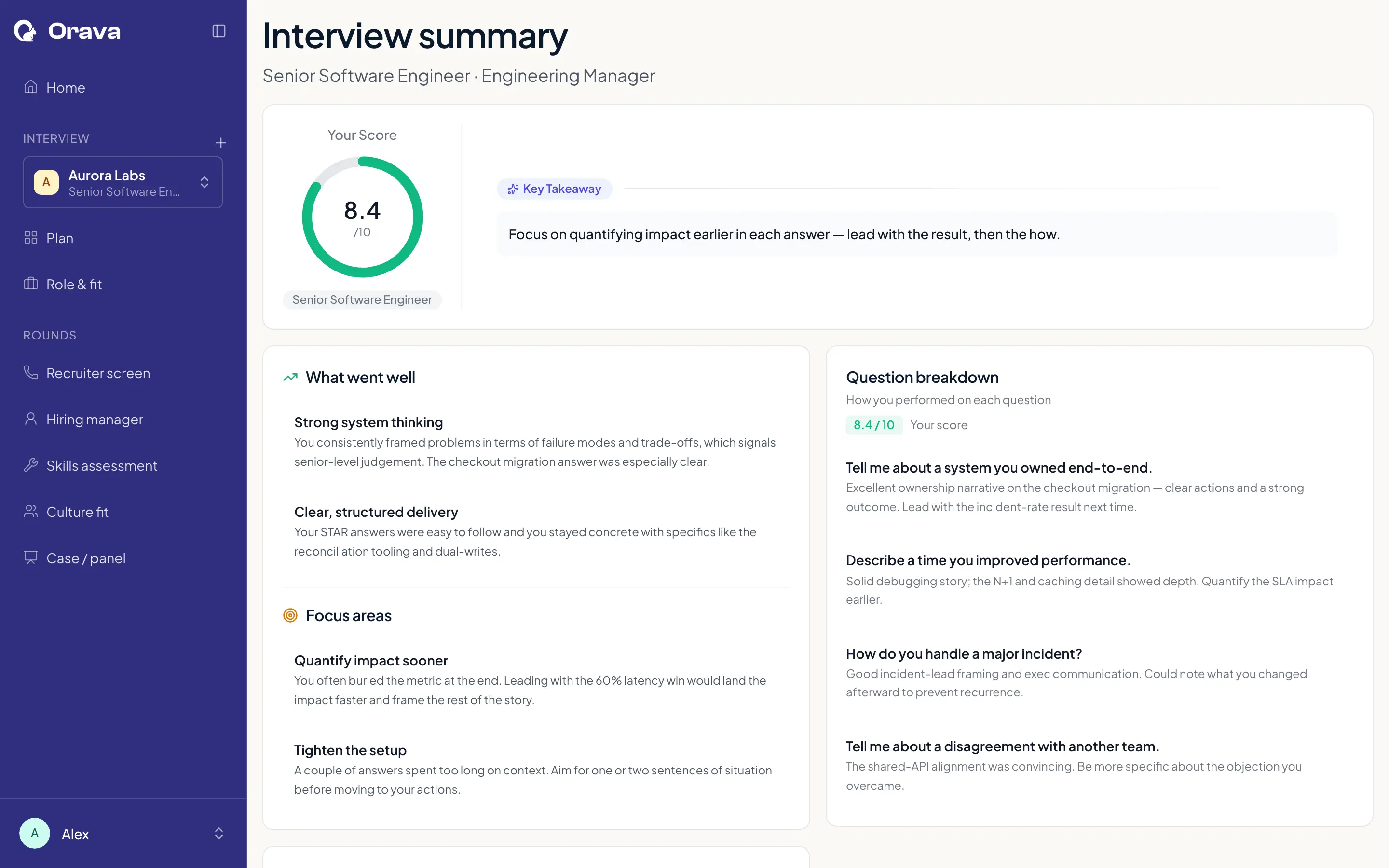
“Tell me about a time you had to debug a complex issue that was affecting users in production”
Preparation Tips for Apple iOS Developer Interviews
- Ask your recruiter or the hiring manager what each round covers; candidates say every team sets its own
- Practice debugging data races and deadlocks with Thread Sanitizer and Instruments
- Practice adding a feature to an unfamiliar Xcode project in under an hour
- Prepare for both practical rounds and CoderPad-style coding; reports differ by team
- Review Swift concurrency, ARC and UIKit basics such as view lifecycle and frame versus bounds
- Prepare short behavioral stories on debugging, design collaboration and performance work
Frequently Asked Questions - Apple iOS Developer
Apple doesn't publish it, and candidates say every team sets its own. Reports from 2023 to 2025 describe a screen with the hiring or engineering manager, a practical coding round (in one case a real-world problem in Xcode), then a virtual onsite of about five interviews, including short behavioral calls. Ask your recruiter or the manager what each round covers.
When checked on October 12, 2026, Apple's iOS postings listed base pay ranges of $150,400–$277,600 for ICT3–ICT4 roles in Cupertino and New York, and $184,700–$324,800 for ICT4–ICT5 roles such as Senior iOS Developer. An ICT2–ICT3 HealthKit role listed $129,300–$225,300 in Sunnyvale. Each range covers the posting's level band and varies by location; postings add discretionary bonuses and restricted stock units.
It depends on the team. A senior candidate reports no LeetCode in the screen or onsite: every technical round was fixing a bug, mostly a data race or deadlock, or extending an app. A 2025 candidate's recruiter said the first round would be a real-world problem in Xcode. A 2023 candidate's onsite still had two CoderPad rounds out of five, so prepare for both.
Swift or Objective-C and user-interface programming with UIKit, SwiftUI or AppKit. Preferred skills include concurrency and memory management, async patterns such as Combine and async/await, profiling UI performance with Instruments, and designing public APIs used by other teams. The Wallet posting also lists experience incorporating AI tools into development.
Candidates report basic iOS questions tied to the resume, with UIKit specifics, and practical work: finding and fixing data races or deadlocks, and extending an existing app. Be ready to explain view lifecycle, frame versus bounds, ARC and retain cycles, and Swift concurrency, and to debug with Xcode's tools rather than by reading code alone.
Sources
- Apple job posting: iOS Engineer, Wallet
- Apple job posting: Senior iOS Engineer, Apple Games
- Apple job posting: Senior iOS Developer
- Blind: Apple iOS software engineer interview, Jun 2025 (candidate reports)
- Blind: Apple iOS SWE virtual onsite, Oct 2023 (candidate report)
- Blind: Apple iOS interview, Dec 2023 (candidate report)
- Taro: Apple iOS software developer, Seattle, Feb 2025 (candidate report)
Applying for this role?
Paste the Apple posting and your resume. See which requirements your resume already proves, and which answers to prepare first.
Compare my resume to this roleFree · no account needed