
Anthropic Machine Learning Systems Engineer Interview Questions (2026)
4 min read10 practice questionsUpdated Sep 29, 2026
Machine Learning Systems Engineer interviews test how you reason through a technical problem out loud: the approach you pick, the trade-offs you name and how you check your work. This guide walks through the Anthropic process stage by stage, then gives cultural fit, behavioral, product, technical and system design practice questions with notes on how to answer them.
Hear how your answer lands before the interview
“Tell me about a time you built or improved a system that other engineers or researchers depended on directly. How did you handle their changing requirements?”
Rehearse my answerFree · no account needed
The Anthropic Machine Learning Systems Engineer Interview Process
What to expect at each stage of the Anthropic Machine Learning Systems Engineer loop.
- 1
Introductory conversation
Your background, motivation, and which ML systems team (RL Engineering, Research Tools/Encodings, Safeguards) you're interviewing for.
- 2
Technical deep dive
Prior ML-systems work — RL infrastructure, tokenization/encoding pipelines, or similar training-facing tooling.
- 3
Technical exercise
Role-relevant coding or systems design problem. Anthropic notes technical interviews may use tools such as Colab or CodeSignal.
- 4
Systems and correctness judgment
How you validate performance changes don't silently alter model behavior, and how you debug ambiguous ML-systems failures.
- 5
Team and mission conversations
Fit with the specific team and motivation for Anthropic's safety-focused mission.
Sample Anthropic Machine Learning Systems Engineer Interview Questions
Cultural Fit Questions
1 question- 1
Anthropic's mission is to ensure AI systems are developed safely. How does that shape the way you'd approach building ML training systems that researchers depend on?
How to answer: Connect concretely: e.g., how correctness bugs in training infrastructure can silently corrupt results researchers use to make safety-relevant claims, and how you'd design for catching that early.
“Tell me about yourself”, “Why here?” and the other common questions, and how to prep each →
Behavioral Questions
3 questions- 1
Tell me about a time you built or improved a system that other engineers or researchers depended on directly. How did you handle their changing requirements?
How to answer: Use STAR. Show you can build for users who aren't you — API ergonomics, documentation, backward compatibility — while still moving fast.
- 2
Describe a time you found a subtle correctness bug in an ML system (e.g., a tokenization edge case, a reward-signal bug, a distributed training race condition). How did you find and fix it?
How to answer: Emphasize the debugging methodology — how you noticed something was off, isolated the cause, and validated the fix didn't introduce a new problem.
- 3
Tell me about a time you had to make a trade-off between system performance and correctness or safety guarantees.
How to answer: Show you can articulate both sides of the trade-off and the reasoning behind your final call, not just the outcome.
The six topics behind behavioral questions, and how to prep a story for each →
Product Questions
1 question- 1
How would you prioritize between fixing a known but rare bug in production training infrastructure versus shipping a requested new feature?
How to answer: There's no universally correct answer — show judgment about blast radius, how the bug affects research validity, and how you'd communicate trade-offs to stakeholders.
Technical Questions
3 questions- 1
Explain how you would debug a training run where loss looks normal but downstream eval performance has regressed.
How to answer: Walk through hypothesis generation (data pipeline change, eval harness bug, subtle numerical issue) and how you'd narrow down the cause systematically rather than guessing.
- 2
How do you approach validating that a performance optimization (e.g., a faster tokenizer, a kernel change) hasn't subtly changed model behavior?
How to answer: Discuss numerical parity testing, A/B comparison of downstream metrics, and why 'faster and looks the same' isn't sufficient proof of correctness.
- 3
A research team says their finetuning jobs have become unreliable — intermittent failures with no clear pattern. How would you investigate?
How to answer: Show a structured investigation: gathering failure logs, looking for resource contention or race conditions, reproducing at smaller scale, and how you'd communicate findings back to the team.
System Design Questions
2 questions- 1
Design a tokenization pipeline that needs to stay consistent across training and finetuning workflows for a model serving many downstream use cases.
How to answer: Cover versioning, backward compatibility when the tokenizer changes, edge cases (multilingual text, special tokens), and how you'd test for silent encoding mismatches.
- 2
How would you design the infrastructure for an RL engineering system that needs to run many parallel rollouts efficiently?
How to answer: Discuss parallelism strategy, reward computation bottlenecks, sample efficiency vs. wall-clock time trade-offs, and observability into what the policy is actually learning.
System design questions grouped by the concept they test, with a full walkthrough →
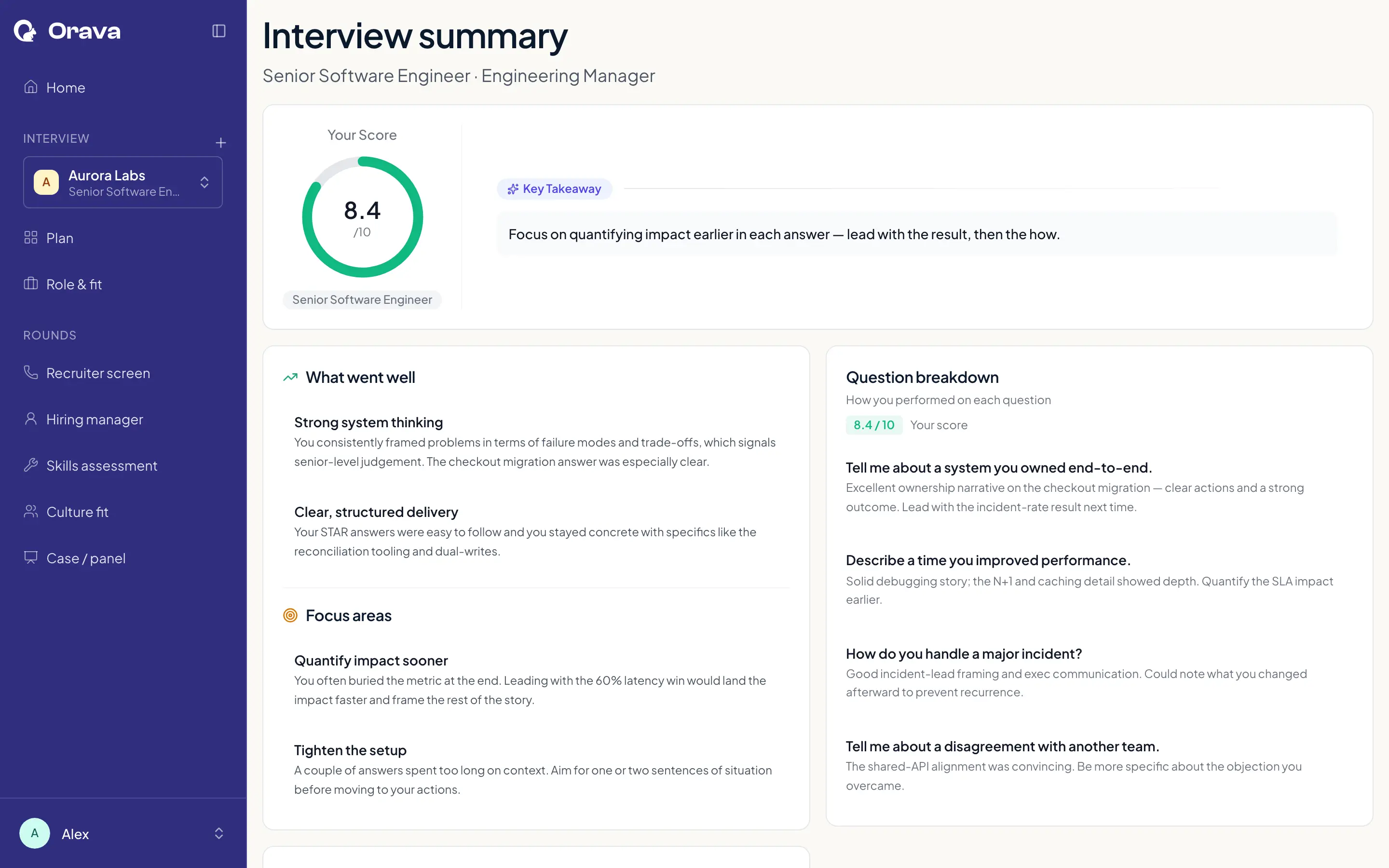
Rehearse this one out loud:
“Tell me about a time you built or improved a system that other engineers or researchers depended on directly. How did you handle their changing requirements?”
Preparation Tips for Anthropic Machine Learning Systems Engineer Interviews
- Be ready to discuss the specific sub-area (RL engineering, tokenization/encodings, or general ML systems tooling) the posting you're applying to covers — Anthropic's ML systems roles are team-specific, not generic.
- Prepare a detailed story about debugging a subtle correctness issue in an ML system — this is a recurring theme across Anthropic's engineering interviews.
- Practice explaining performance optimizations alongside how you validated correctness — Anthropic cares about both, not speed alone.
- Review the basics of reinforcement learning and tokenization/encoding schemes if your background is more general-systems than ML-specific — the technical rounds assume familiarity with both.
- Read Anthropic's published research to understand how the infrastructure you'd build connects to the models it trains — interviewers often probe this connection.
- If your technical exercise uses Colab or CodeSignal, practice working in a notebook-style environment ahead of time.
Frequently Asked Questions - Anthropic Machine Learning Systems Engineer
A Machine Learning Systems Engineer builds the algorithms and infrastructure that Anthropic's researchers depend on to train models — for example, critical RL engineering systems on the Reinforcement Learning Engineering team, or encodings and tokenization systems used throughout finetuning workflows on the Research Tools team. It's a systems-and-ML-engineering hybrid role, distinct from general distributed-systems infrastructure work.
Infrastructure Engineer at Anthropic focuses on broader distributed-systems reliability — training and serving infrastructure, networking, storage, and safety-critical resilience at scale. Machine Learning Systems Engineer is more specifically about the ML-training-facing layer: RL algorithms and engineering, tokenization and encodings, and the tooling researchers use directly inside training and finetuning workflows. There's overlap, but the day-to-day work and required background differ.
Anthropic's interviews are remote and tailored to background and team. Expect a background/motivation conversation, a deep technical dive into ML systems work you've done, a technical exercise (Anthropic notes these may use tools like Colab or CodeSignal), and team/mission-fit conversations. Because this role sits between research and infrastructure, expect both ML-specific technical questions and systems-engineering questions in the loop.
Deep familiarity with the algorithms and infrastructure that make large-scale model training work — reinforcement learning engineering, encodings/tokenization systems, distributed training internals, and the tooling layer between research code and production training runs. Strong software engineering fundamentals matter as much as ML knowledge, since the code you write is what researchers rely on daily.
A related live posting for a Machine Learning Systems Engineer role on Anthropic's Encodings and Tokenization team lists annual compensation in the range of roughly $320,000–$405,000. Treat this as a reported figure from one specific posting rather than a guarantee across all levels or teams.
Candidates who can point to concrete experience building or optimizing systems that sit close to model training — reinforcement learning infrastructure, tokenization/encoding pipelines, or similar ML-systems tooling — and who can explain both the ML reasoning behind a design choice and the systems trade-offs (throughput, memory, correctness) involved in implementing it.
Sources
Applying for this role?
Paste the Anthropic posting and your resume. See which requirements your resume already proves, and which answers to prepare first.
Compare my resume to this roleFree · no account needed