
OpenAI ML Engineer Interview Questions & Process (2026)
4 min read11 practice questionsUpdated Sep 29, 2026
ML Engineer interviews test how you reason through a technical problem out loud: the approach you pick, the trade-offs you name and how you check your work. This guide gives cultural fit, behavioral, technical and system design practice questions for the OpenAI loop, with notes on how to answer them.
Hear how your answer lands before the interview
“Tell me about the most technically challenging ML system you've built or contributed to. What was the challenge and how did you solve it?”
Rehearse my answerFree · no account needed
Sample OpenAI ML Engineer Interview Questions
Cultural Fit Questions
1 question- 1
How does OpenAI's mission — ensuring AGI benefits all of humanity — shape how you think about the engineering decisions in building and deploying ML models?
How to answer: Connect engineering decisions to safety outcomes: e.g., how training monitoring enables early detection of misaligned behavior, how inference controls implement safety guardrails, how interpretability tooling supports alignment research.
“Tell me about yourself”, “Why here?” and the other common questions, and how to prep each →
Behavioral Questions
3 questions- 1
Tell me about the most technically challenging ML system you've built or contributed to. What was the challenge and how did you solve it?
How to answer: Use STAR method. Emphasize depth: the specific bottleneck, why conventional approaches didn't work, how you designed your solution, how you validated it, and the measurable outcome.
- 2
Describe a time you identified and fixed a numerical instability or convergence issue in a training run. What was the root cause and how did you resolve it?
How to answer: Show debugging methodology: gradient monitoring, loss landscape analysis, learning rate and batch size diagnostics, mixed precision issues. Demonstrate that you've dealt with real training failures, not just textbook problems.
- 3
Tell me about a time you significantly improved the training efficiency or inference throughput of an ML system.
How to answer: Quantify the improvement. Walk through your profiling approach, the bottleneck you identified (compute/memory/communication bound), the optimization you implemented, and how you verified the gain.
The six topics behind behavioral questions, and how to prep a story for each →
Technical Questions
4 questions- 1
Explain how RLHF works and discuss the engineering challenges of implementing it at scale for a frontier language model.
How to answer: Cover the three-phase pipeline (SFT → reward model training → PPO), challenges like reward hacking, KL penalty tuning, infrastructure for synchronised policy and critic updates, sample quality management, and the computational overhead versus DPO/IPO alternatives.
- 2
How would you implement efficient attention for very long context lengths (e.g., 128k tokens) in a Transformer model?
How to answer: Discuss FlashAttention (IO-aware exact attention), sliding window attention, linear attention approximations (Mamba, RWKV), and retrieval-augmented approaches. Explain the memory and compute trade-offs of each.
- 3
Walk me through how you would implement and debug a custom CUDA kernel for a new attention variant not supported by existing libraries.
How to answer: Cover Triton vs raw CUDA, tiling for shared memory efficiency, occupancy vs register pressure trade-offs, profiling with NVIDIA Nsight, and common pitfalls (bank conflicts, warp divergence, async memory issues).
- 4
A training run for a new model shows the loss is decreasing but human evaluators say output quality has degraded. How do you diagnose this?
How to answer: Show systematic debugging: check for reward hacking (reward model overoptimisation), mode collapse on diverse capabilities, distribution shift in generated text, calibration degradation. Propose targeted evals to isolate the problem.
System Design Questions
3 questions- 1
Design the distributed training infrastructure for a 70B+ parameter language model across 1,000 GPU nodes.
How to answer: Cover parallelism strategy (3D parallelism: data + tensor + pipeline), gradient checkpointing for memory reduction, mixed precision (BF16 + FP32 master weights), communication topology (NVLink, InfiniBand), checkpoint frequency and storage, and failure recovery without losing the full training run.
- 2
How would you design an efficient inference serving system for a large language model that must handle 100k concurrent users with P99 latency under 2 seconds?
How to answer: Discuss continuous batching, KV-cache management, speculative decoding, model sharding for multi-GPU inference, autoscaling policies, request routing, and how you'd handle the memory bandwidth bottleneck of attention at long context lengths.
- 3
How would you design a monitoring system to detect safety-relevant failure modes in a deployed language model — e.g., policy violations, unexpected output distributions, or capability regressions?
How to answer: Cover real-time output sampling for automated policy classifiers, embedding distribution drift monitoring, capability benchmark regression tests in CI, human review sampling pipelines, and incident escalation thresholds.
System design questions grouped by the concept they test, with a full walkthrough →
Rehearse this one out loud:
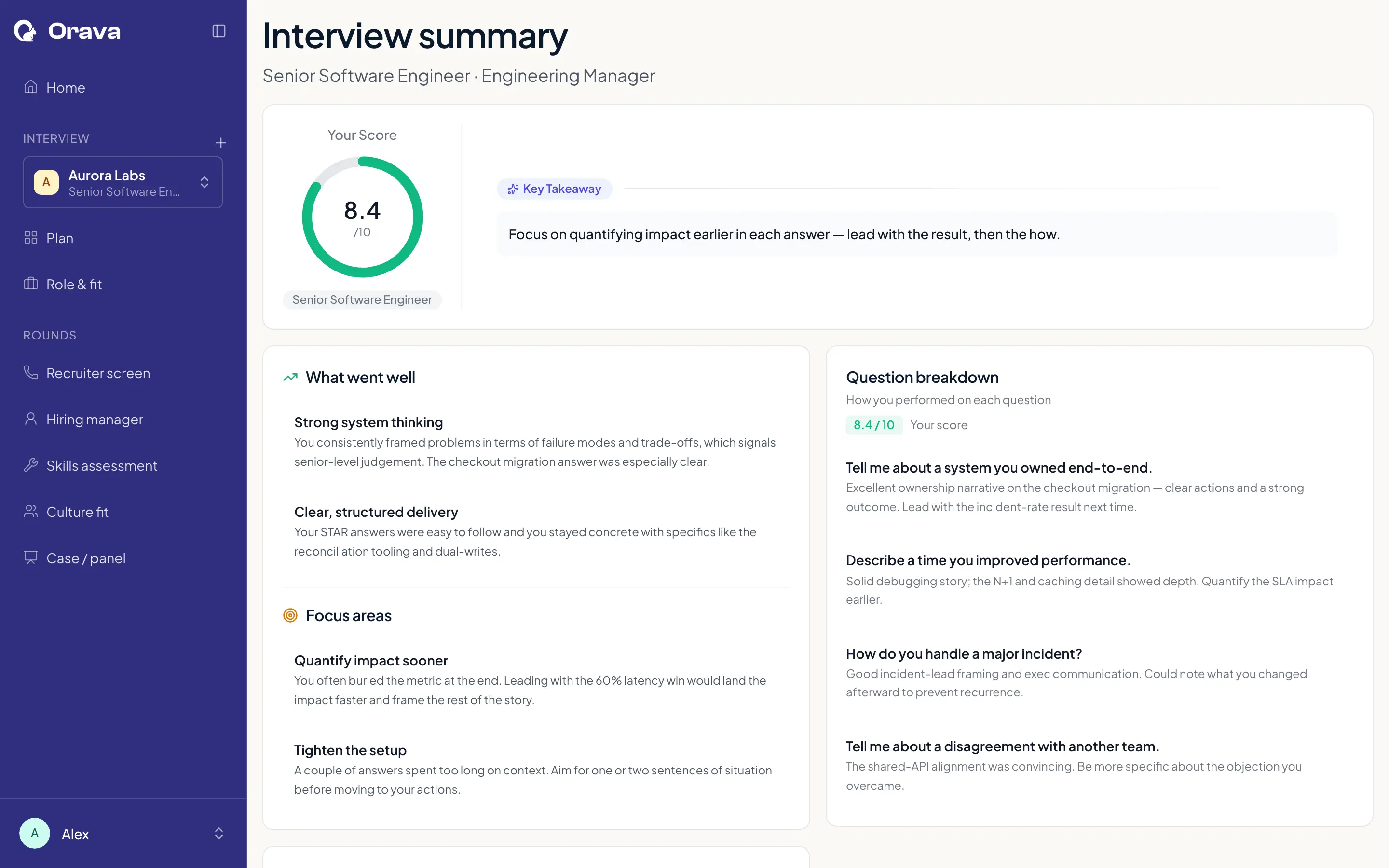
“Tell me about the most technically challenging ML system you've built or contributed to. What was the challenge and how did you solve it?”
Preparation Tips for OpenAI ML Engineer Interviews
- Study Transformer architecture deeply — attention mechanisms, scaling laws, positional encodings, and modern architecture variants (Llama, Mistral, Gemma)
- Practice implementing ML components from scratch in PyTorch: attention, layer norm, custom data loaders, training loops with gradient accumulation
- Study distributed training: FSDP, DeepSpeed ZeRO stages, tensor parallelism (Megatron), and pipeline parallelism — know the memory/communication trade-offs
- Read OpenAI's key papers (GPT-3, InstructGPT, RLHF, Codex, GPT-4 technical report) and be ready to discuss engineering decisions
- Learn inference optimization: quantisation (GPTQ, AWQ), speculative decoding, KV-cache optimization, and continuous batching
- Demonstrate genuine mission alignment — OpenAI ML Engineers are expected to think about safety implications of their engineering choices
- Know FlashAttention and understand why IO-aware kernel design matters for Transformer training and inference efficiency
Frequently Asked Questions - OpenAI ML Engineer
The OpenAI ML Engineer process typically includes 5-6 rounds: a recruiter screen (30 min), a technical phone screen covering ML fundamentals and coding (60 min), a machine learning system design interview (60 min), a deep-dive ML coding round (60 min), a values and safety alignment interview (45 min), and a final cross-functional loop. Expect a higher bar on both ML theory and engineering execution than a typical industry ML role — OpenAI works at the frontier.
Core requirements: deep understanding of neural network architectures (Transformers, attention mechanisms, scaling laws), PyTorch proficiency at production level (custom CUDA kernels, distributed training with FSDP/DeepSpeed, mixed precision), strong software engineering skills (systems design, clean code, testing), and experience with ML training infrastructure at scale. RLHF, preference learning, and safety-relevant ML techniques are highly valued. Familiarity with inference optimization (quantisation, speculative decoding, KV-cache management) is increasingly important.
Review Transformer architecture deeply — attention, positional encoding, layer normalisation, scaling behavior. Study distributed training patterns (data parallelism, model parallelism, tensor parallelism, pipeline parallelism) and their trade-offs. Practice implementing ML components from scratch in PyTorch. Read OpenAI's key papers (GPT series, InstructGPT, RLHF, Codex) and be ready to discuss the engineering decisions they describe. Be prepared to reason about numerical stability, memory optimization, and throughput vs latency trade-offs.
Pay varies by level, location and team. Many postings list a base-pay range (US postings in states such as California and New York are required to), so check the posting for your role and ask your recruiter how equity and any bonus work at your level.
Standout candidates combine research-level ML understanding with strong production engineering skills — they can implement and optimize the systems that train and serve frontier models. They show genuine curiosity about ML safety, demonstrate understanding of OpenAI's research direction, and can reason clearly about the engineering trade-offs involved in training large models responsibly. Open-source contributions to ML infrastructure (PyTorch, Triton, DeepSpeed) or published research are strong differentiators.
Applying for this role?
Paste the OpenAI posting and your resume. See which requirements your resume already proves, and which answers to prepare first.
Compare my resume to this roleFree · no account needed
