OpenAI Product Designer Interview Questions & Process (2026)
4 min read11 practice questionsUpdated Sep 29, 2026
Product Designer interviews test how you frame a problem, the decisions behind your work and how you present and defend them. This guide gives cultural fit, behavioral, product and case study practice questions for the OpenAI loop, with notes on how to answer them.
Hear how your answer lands before the interview
“Walk me through a design project you're most proud of. What was the problem, your process, and the outcome?”
Rehearse my answerFree · no account needed
Sample OpenAI Product Designer Interview Questions
Cultural Fit Questions
1 question- 1
How does OpenAI's mission to develop AI that is safe and beneficial to humanity shape how you think about designing user experiences for AI products?
How to answer: Go beyond surface-level safety messaging. Discuss transparency (communicating model uncertainty, limitations), trust calibration (avoiding over-trust and AI dependency), user control, and how you'd design for diverse users who may misunderstand AI capabilities.
“Tell me about yourself”, “Why here?” and the other common questions, and how to prep each →
Behavioral Questions
3 questions- 1
Walk me through a design project you're most proud of. What was the problem, your process, and the outcome?
How to answer: Structure as a clear narrative: problem framing → research insights → design exploration → iteration → final solution → impact. Show your thinking process, not just the end artefact. Be ready for deep follow-up questions.
- 2
Tell me about a time you had to design for a highly uncertain or ambiguous problem space. How did you approach it?
How to answer: Show comfort with ambiguity: how you defined the problem through research, how you made decisions with incomplete information, how you communicated uncertainty in your designs, and how you iterated based on feedback.
- 3
Describe a situation where your design was significantly changed by engineering or product constraints. How did you handle it?
How to answer: Demonstrate collaborative problem solving and pragmatism. Show that you can advocate for user needs while finding creative solutions within real-world constraints — and know when to escalate versus adapt.
The six topics behind behavioral questions, and how to prep a story for each →
Product Questions
6 questions- 1
Design the onboarding experience for a new ChatGPT Enterprise user who has never used a large language model before.
How to answer: Consider: calibrating expectations (what it can and can't do), safety and privacy orientation (enterprise data handling), progressive disclosure vs immediate capability access, prompting guidance, and how you'd measure onboarding success.
- 2
How would you redesign ChatGPT's conversation interface to better help users understand when the model is confident versus uncertain in its responses?
How to answer: Explore interaction models: inline confidence indicators, source citations, explicit uncertainty language, alternative suggestions, user verification flows. Discuss trade-offs between information richness and cognitive load. Prototype at least two distinct directions.
- 3
Design a system for allowing users to customize their AI assistant's behavior — tone, depth, safety guardrails — in a way that is powerful but not overwhelming.
How to answer: Discuss the tension between advanced user control and accessibility. Propose a tiered settings model (sensible defaults + progressive disclosure of power user options). Consider how changes affect trust and how you'd design rollback/reset flows.
- 4
How would you design the experience for users who want to give feedback on a ChatGPT response that they found harmful or incorrect?
How to answer: Cover the end-to-end feedback flow: in-context reporting, feedback categorisation (harmful vs factually wrong vs style preference), acknowledgement to the user, and how you'd design the experience to encourage high-quality feedback without overburdening users.
- 5
What principles would you use to design AI interactions that build appropriate user trust — neither over-trust nor under-trust in AI capabilities?
How to answer: Demonstrate nuanced thinking about AI UX: calibrated confidence signalling, progressive capability disclosure, graceful failure design, human oversight mechanisms, and how design choices affect long-term user behavior and reliance.
- 6
Critique an AI product interface of your choice. What works well, what doesn't, and what would you change?
How to answer: Choose a product you know well and can discuss with specificity. Structure your critique: identify design intentions, where they succeed, where they fail (and why), and propose concrete improvements grounded in user needs rather than aesthetic preference.
Case Study Questions
1 question- 1
You're designing a new OpenAI product feature and discover through user research that a significant portion of users are using it in ways that could be harmful to themselves. How do you respond as the designer?
How to answer: Show ethical design thinking: distinguishing user desire from user wellbeing, working with safety and policy teams, exploring design interventions (friction, guardrails, education), and escalating when design alone can't solve the problem.
Rehearse this one out loud:
“Walk me through a design project you're most proud of. What was the problem, your process, and the outcome?”
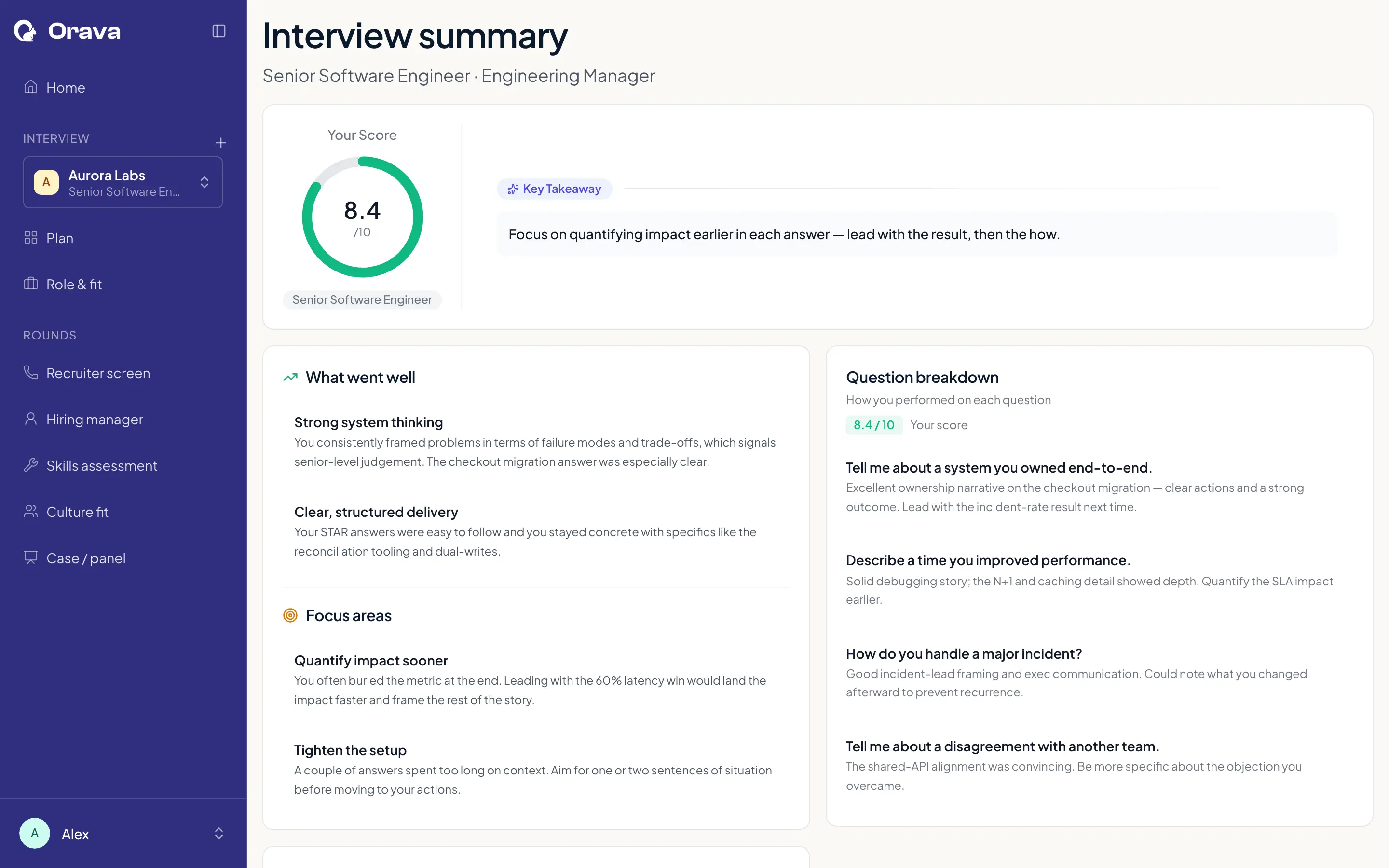
Preparation Tips for OpenAI Product Designer Interviews
- Build deep fluency with AI-native design patterns — conversational interfaces, prompt design, uncertainty communication, and graceful failure states for generative AI
- Study OpenAI's existing products (ChatGPT, API Playground, DALL-E) critically — be ready to critique and improve them intelligently
- Prepare 2-3 portfolio case studies with strong process narratives — OpenAI cares as much about how you think as what you made
- Practice rapid design critiques and whiteboard challenges — design exercises are common in OpenAI loops
- Demonstrate genuine engagement with AI safety and ethics as a designer — this is not just a policy concern but a core UX challenge at OpenAI
- Show strong systems thinking: AI products require design for edge cases, failure states, and non-linear user journeys at scale
- Be ready to articulate the limitations of your design decisions and what you'd explore with more time or data
Frequently Asked Questions - OpenAI Product Designer
The OpenAI Product Designer process typically includes 5-6 rounds: a recruiter screen (30 min), a portfolio review with a hiring manager (60 min), a design challenge or take-home (1-2 days), a design critique and presentation (60 min), a cross-functional collaboration interview with PM and engineering (45 min), and a values alignment round. OpenAI strongly evaluates the ability to design novel AI-native experiences where established patterns don't yet exist.
Core requirements: strong interaction and visual design fundamentals, experience designing conversational or AI-powered interfaces, systems thinking for complex multi-modal products, proficiency with Figma (prototyping, component systems, auto-layout), user research skills, and the ability to design for ambiguity. Designers are expected to navigate the unique challenges of AI UX — communicating uncertainty, managing user trust, and designing transparent, safe interactions with AI systems.
Curate 2-3 deep case studies that show your end-to-end design process — research, ideation, iteration, and impact. Include at least one project involving ambiguous or novel problem spaces. If you have AI or conversational interface experience, feature it prominently. Be ready to discuss: what constraints shaped your decisions, how you handled edge cases and failure states, how you collaborated with engineers and PMs, and what you'd do differently with hindsight. Show visual craftsmanship and systematic design thinking.
Pay varies by level, location and team. Many postings list a base-pay range (US postings in states such as California and New York are required to), so check the posting for your role and ask your recruiter how equity and any bonus work at your level.
Standout candidates demonstrate the ability to design novel AI-native experiences rather than retrofitting traditional UI patterns onto AI capabilities. They show deep craft (visual design, interaction design, motion), strong research instincts, and the ability to work through deep ambiguity. They engage seriously with AI safety and ethics in their design process — designing for transparency, user control, and appropriate trust calibration — and can communicate design decisions clearly to technical audiences.
Applying for this role?
Paste the OpenAI posting and your resume. See which requirements your resume already proves, and which answers to prepare first.
Compare my resume to this roleFree · no account needed