Google Software Engineer Interview Questions (2026)
4 min read16 practice questionsUpdated Sep 29, 2026
Software Engineer interviews test how you reason through a technical problem out loud: the approach you pick, the trade-offs you name and how you check your work. This guide gives cultural fit, behavioral, technical and system design practice questions for the Google loop, with notes on how to answer them.
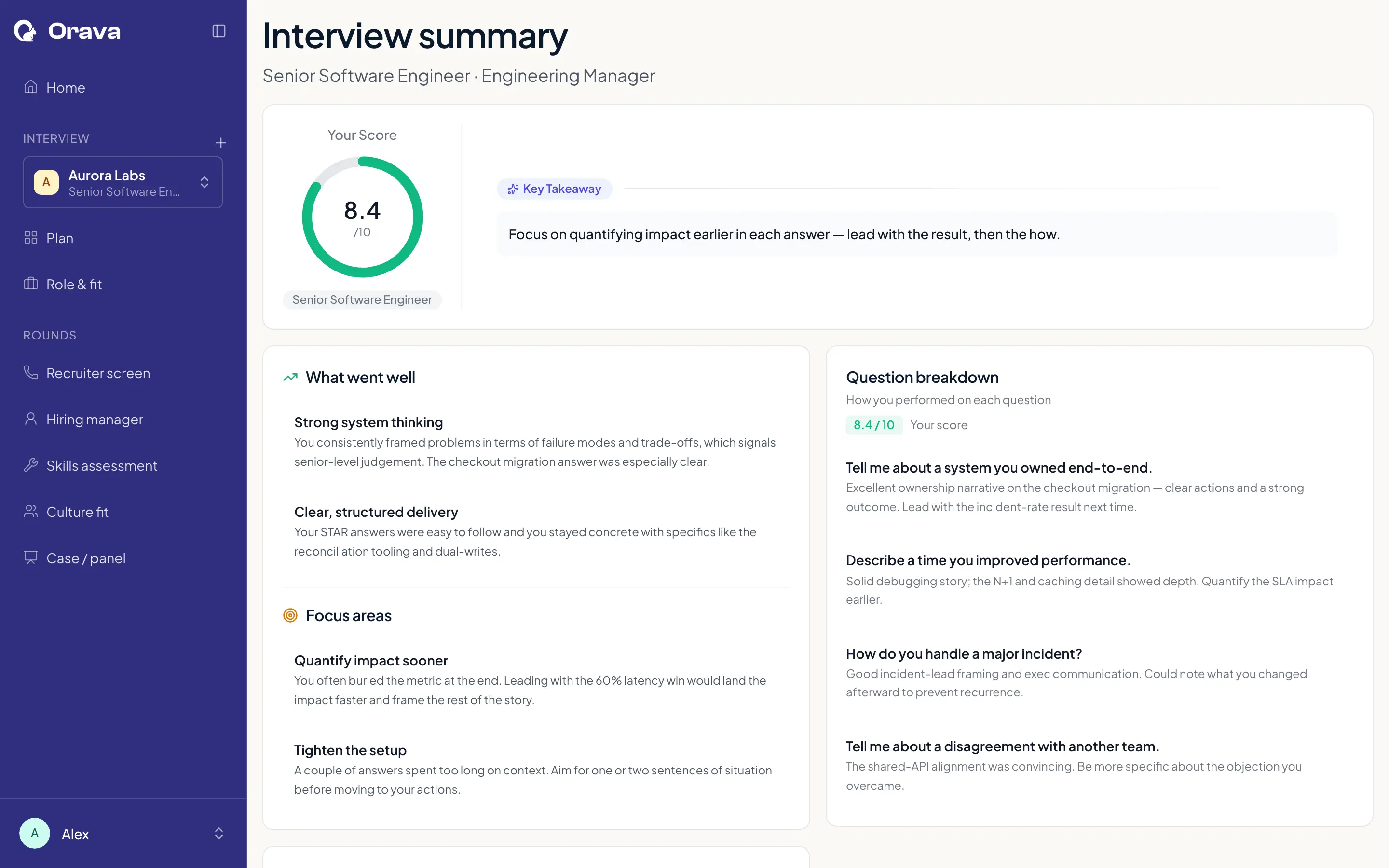
Hear how your answer lands before the interview
“Tell me about a time you had to solve a complex technical problem with limited information”
Rehearse my answerFree · no account needed
Sample Google Software Engineer Interview Questions
Cultural Fit Questions
1 question- 1
How do you embody Google's mission to organize the world's information and make it universally accessible?
Mid-levelHow to answer: Show understanding of Google's global impact, commitment to accessibility, and democratization of information.
“Tell me about yourself”, “Why here?” and the other common questions, and how to prep each →
Behavioral Questions
3 questions- 1
Tell me about a time you had to solve a complex technical problem with limited information
Mid-levelHow to answer: Use STAR method. Show analytical thinking, research approach, and how you broke down the problem systematically.
- 2
Describe a situation where you had to collaborate with a team to deliver under tight deadlines
Mid-levelHow to answer: Demonstrate teamwork, communication skills, prioritization, and how you ensured quality under pressure.
- 3
Walk me through a time when you had to learn a new technology or framework quickly
Mid-levelHow to answer: Show learning agility, resourcefulness, and how you applied new knowledge to solve real problems.
The six topics behind behavioral questions, and how to prep a story for each →
Technical Questions
7 questions- 1
Implement a LRU cache with O(1) operations
SeniorHow to answer: Use HashMap and doubly linked list. Walk through get/put operations and explain eviction strategy.
- 2
Find the minimum number of meeting rooms required
Mid-levelHow to answer: Sort intervals by start time, use min-heap or greedy approach. Consider edge cases and complexity.
- 3
How would you detect cycles in a large graph?
SeniorHow to answer: Discuss DFS with coloring, memory constraints for large graphs, and distributed approaches.
- 4
Implement a thread-safe singleton pattern
Mid-levelHow to answer: Show double-checked locking, static initialization, or enum approaches. Discuss performance implications.
- 5
How would you optimize Google Maps routing?
SeniorHow to answer: Discuss preprocessing, A* algorithm, traffic data integration, and real-time route adjustments.
- 6
Debug a performance issue in a microservice receiving 1M+ requests per second
SeniorHow to answer: Walk through monitoring, profiling, database optimization, caching strategies, and gradual rollout of fixes.
- 7
Optimize a slow database query affecting millions of users
SeniorHow to answer: Cover indexing strategies, query analysis, sharding considerations, and gradual deployment of optimizations.
System Design Questions
5 questions- 1
Design a system like Google Search
SeniorHow to answer: Focus on indexing, ranking algorithms, distributed storage, and query processing at massive scale.
- 2
Design a distributed file storage system
SeniorHow to answer: Address replication, consistency, partition tolerance, and metadata management across nodes.
- 3
Implement autocomplete for Google Search
SeniorHow to answer: Consider trie data structure, caching strategies, personalization, and real-time updates.
- 4
Design an A/B testing framework for Google products
SeniorHow to answer: Consider statistical significance, user bucketing, data collection, and integration with multiple product surfaces.
- 5
How would you implement real-time collaborative editing like Google Docs?
SeniorHow to answer: Discuss operational transformation, conflict resolution, WebSocket connections, and state synchronization.
System design questions grouped by the concept they test, with a full walkthrough →
Rehearse this one out loud:
“Tell me about a time you had to solve a complex technical problem with limited information”
Preparation Tips for Google Software Engineer Interviews
- Practice system design at scale and distributed architectures
- Master algorithms, data structures, and coding fundamentals
- Be ready to discuss technical trade-offs and complexity analysis
- Study Google's infrastructure and cloud technologies
- Prepare for behavioral questions about technical leadership
- Practice coding in a shared document without IDE assistance
Frequently Asked Questions - Google Software Engineer
Google's SWE interview process includes: 1) Phone/video technical screen (45-60 min coding), 2) On-site loop with 4-5 interviews covering algorithms, system design, and behavioral questions. Technical interviews use a shared doc for coding, focus on data structures/algorithms, and emphasize clean, working code. Prepare by practicing 200+ LeetCode problems, studying system design patterns, and preparing STAR-method behavioral examples. Google values collaborative problem-solving, so think out loud and ask clarifying questions.
Google expects strong proficiency in: data structures (arrays, trees, graphs, hashmaps), algorithms (sorting, searching, dynamic programming), complexity analysis (time/space), and clean coding practices. Master common patterns: two pointers, sliding window, BFS/DFS, backtracking, and greedy algorithms. Practice coding in your preferred language without IDE assistance. For senior roles, also prepare distributed systems, concurrency, and architecture design questions.
Google system design questions focus on scale: 'Design Google Search', 'Design YouTube', 'Design a distributed file system', 'Design URL shortener at Google scale'. Key concepts include: horizontal scaling, load balancing, database sharding, caching strategies, CDNs, and microservices. Always consider Google-scale requirements (billions of users), discuss trade-offs, and think about consistency, availability, and partition tolerance.
While you don't need deep knowledge of Google's internal systems, understanding their approach helps: MapReduce/Big Data processing, distributed computing principles, machine learning at scale, and cloud architecture patterns. Study Google's published research papers, understand their engineering blog posts, and be familiar with GCP services. Show interest in solving problems at Google's scale and complexity.
Pay varies by level, location and team. Many postings list a base-pay range (US postings in states such as California and New York are required to), so check the posting for your role and ask your recruiter how equity and any bonus work at your level. Strong benefits, learning opportunities, and potential for rapid career growth in technical or management tracks.
Applying for this role?
Paste the Google posting and your resume. See which requirements your resume already proves, and which answers to prepare first.
Compare my resume to this roleFree · no account needed