
Uber Software Engineer Interview Questions & Process (2026)
4 min read12 practice questionsUpdated Sep 29, 2026
Software Engineer interviews test how you reason through a technical problem out loud: the approach you pick, the trade-offs you name and how you check your work. This guide gives cultural fit, behavioral, technical and system design practice questions for the Uber loop, with notes on how to answer them.
Hear how your answer lands before the interview
“Tell me about a time you built or scaled a system that had to handle an unexpectedly large volume of traffic.”
Rehearse my answerFree · no account needed
Sample Uber Software Engineer Interview Questions
Cultural Fit Questions
1 question- 1
How does Uber's 'Act Like an Owner' value influence how you approach engineering decisions?
Mid-levelHow to answer: Reference Uber's cultural value of end-to-end ownership. Give a concrete example of taking responsibility beyond your immediate scope — e.g., monitoring a system you shipped, fixing a downstream bug you didn't cause, or driving a post-mortem to resolution.
“Tell me about yourself”, “Why here?” and the other common questions, and how to prep each →
Behavioral Questions
4 questions- 1
Tell me about a time you built or scaled a system that had to handle an unexpectedly large volume of traffic.
SeniorHow to answer: Use STAR method. Quantify the scale — orders of magnitude, requests per second, data volume. Describe the bottlenecks you identified, the changes you made, and how you validated the improvement. Mention monitoring and alerting you set up to detect future spikes.
- 2
Describe a situation where you had to make a critical engineering decision under significant time pressure with incomplete information.
SeniorHow to answer: Show how you gathered just enough data to reduce risk without analysis paralysis. Highlight the trade-offs you weighed, how you communicated the decision and its risks to stakeholders, and how you handled the outcome — whether it succeeded or required course correction.
- 3
Tell me about a time you identified and resolved a systemic reliability problem before it caused significant customer impact.
Mid-levelHow to answer: Focus on proactive detection (monitoring, alerting, code review) rather than reactive firefighting. Describe root cause analysis, the fix, and prevention mechanisms you put in place. Quantify the potential impact avoided.
- 4
Describe a project where you had to collaborate across multiple teams with competing priorities to ship a technically complex feature.
Mid-levelHow to answer: Emphasize how you drove alignment, managed dependencies, and kept the project moving. Show technical communication skills — translating complex trade-offs for non-engineers — and how you maintained relationships while advocating for the right technical approach.
The six topics behind behavioral questions, and how to prep a story for each →
Technical Questions
5 questions- 1
Implement a function to determine if a GPS coordinate falls within a defined geographic polygon.
Mid-levelHow to answer: Discuss the ray-casting algorithm for point-in-polygon detection. Mention edge cases (coordinates on boundaries, antipodal polygons). For Uber scale, explain how you'd preprocess regions using H3 or geohash for O(1) lookup instead of per-request polygon math.
- 2
Design and implement a distributed rate limiter for Uber's driver-partner API endpoints.
SeniorHow to answer: Compare sliding window vs. token bucket algorithms — token bucket is typically better for bursty traffic. For distributed rate limiting, discuss Redis atomic operations (INCR + EXPIRE) or Lua scripts for consistency. Address failure modes: what happens if Redis is unavailable?
- 3
How would you implement a surge pricing algorithm that dynamically adjusts fares based on real-time supply and demand?
SeniorHow to answer: Consider the inputs: demand signals (ride requests per geohash cell), supply signals (available drivers), and a multiplier function. Discuss latency requirements (must be near real-time), geographic granularity, price fairness constraints, and how you'd A/B test multiplier curves without harming rider experience.
- 4
Uber experiences a 10x traffic spike during a major city event. Walk through how you'd diagnose and mitigate the impact.
SeniorHow to answer: Cover the full incident lifecycle: detection (latency and error rate dashboards, SLO burn alerts), triage (identify bottleneck — DB, cache, compute), short-term mitigation (auto-scaling, circuit breakers, traffic shedding of non-critical requests), communication to stakeholders, and post-incident review with preventive measures for next time.
- 5
How would you improve Uber's ETA prediction accuracy by 20% without degrading latency?
SeniorHow to answer: Break into data pipeline (historical trip data, real-time traffic, weather, events), model iteration (ensemble models, contextual features), and serving constraints (must respond in <100ms during matching). Discuss A/B testing methodology for ETA improvements, metrics (mean absolute error, % trips within 2 min of predicted ETA), and the trust impact of inaccurate ETAs on driver and rider behavior.
System Design Questions
2 questions- 1
Design Uber's ride-matching system.
SeniorHow to answer: Cover: geospatial indexing to find nearby drivers (H3 hexagonal grid or geohash), dispatch algorithm (nearest driver vs. predicted ETA vs. ML-ranked), latency budget (under 1 second to first match), region-based partitioning for global scale, and handling surge scenarios where supply is exhausted. Discuss consistency trade-offs when assigning a driver to multiple simultaneous requests.
- 2
Design Uber's real-time driver location tracking system.
SeniorHow to answer: Consider update frequency (every 4 seconds per driver × millions of active drivers = billions of writes/day), storage choices (write-optimized like Cassandra or Redis for hot data), efficient geospatial queries for nearby driver lookups, client-server communication (WebSocket vs. long polling), and privacy constraints around location retention.
System design questions grouped by the concept they test, with a full walkthrough →
Rehearse this one out loud:
“Tell me about a time you built or scaled a system that had to handle an unexpectedly large volume of traffic.”
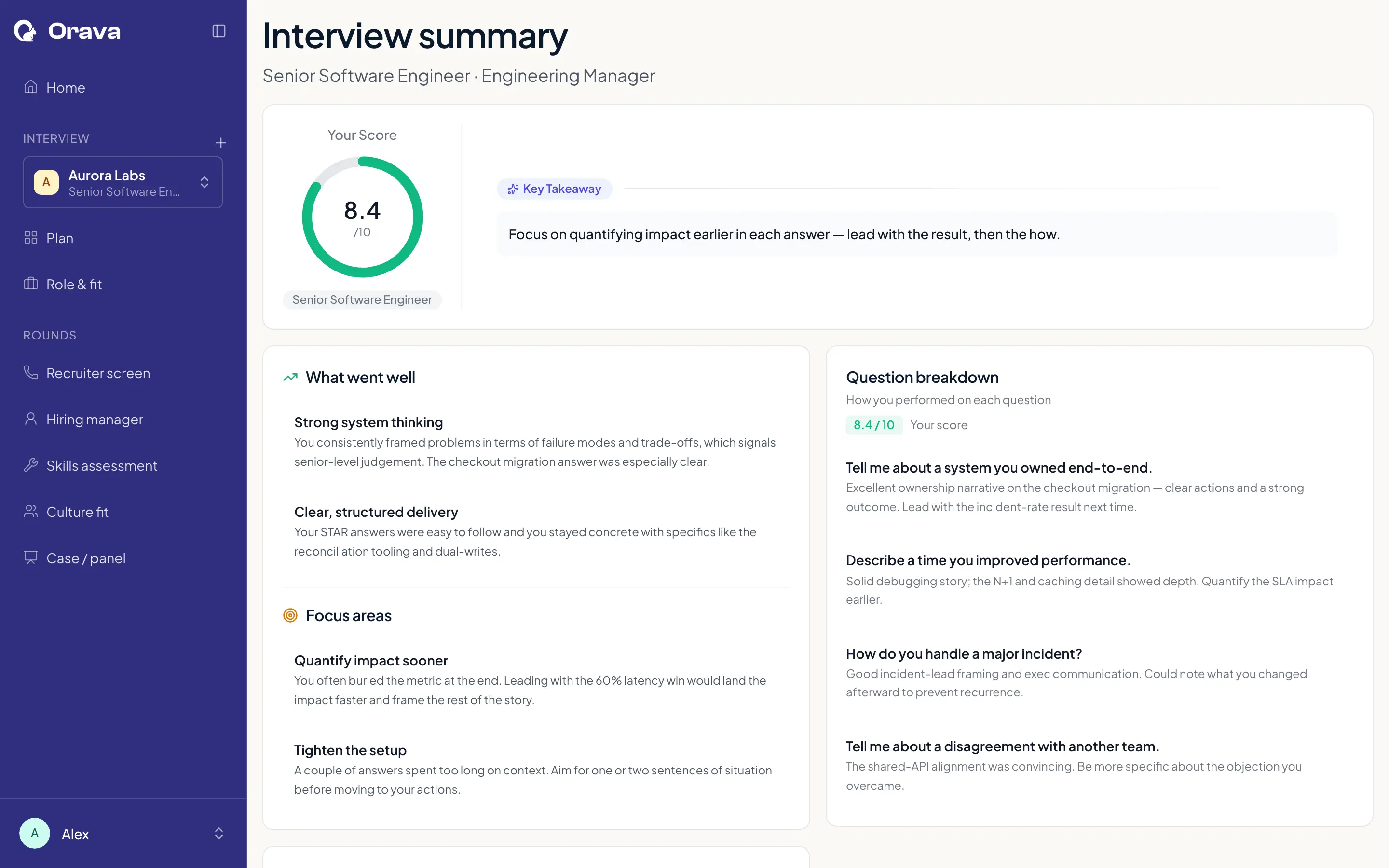
Preparation Tips for Uber Software Engineer Interviews
- Read Uber's engineering blog (eng.uber.com) before your interview — system design questions frequently mirror real Uber systems like H3 geospatial indexing, Cadence workflow orchestration, and Ringpop for distributed membership.
- Practice geospatial algorithms: geohash encoding/decoding, H3 hexagonal indexing, point-in-polygon detection, and nearest-neighbor lookup — these appear in Uber-specific technical and design questions.
- Demonstrate 'Act Like an Owner' in every behavioral answer — Uber values engineers who take end-to-end responsibility, proactively identify problems, and own outcomes through to resolution.
- Review distributed systems fundamentals with Uber's domain in mind: consistent hashing, event-driven architecture with Kafka, eventually-consistent stores (Cassandra), and Redis for caching and coordination.
- For coding rounds, focus on graph algorithms (BFS, Dijkstra — routing problems), dynamic programming, and hash table design. Uber coding is typically done in CoderPad without IDE autocomplete, so practice writing clean code by hand.
- Prepare 2–3 STAR stories with quantified impact about operating at scale, handling reliability incidents, and making high-stakes decisions under ambiguity.
- For system design, always anchor your architecture to Uber's actual scale: millions of active trips, 70+ countries, sub-second dispatch latency — generic textbook answers won't differentiate you.
Frequently Asked Questions - Uber Software Engineer
Uber's SWE interview has four stages: (1) recruiter screen (15–30 min), (2) online assessment via HackerRank (2 coding problems, 90 min), (3) technical phone screen (45–60 min, 1–2 coding problems plus brief system design), and (4) virtual onsite with 4–5 rounds covering algorithms, system design, and behavioral/culture fit. The full process typically takes 3–5 weeks. Senior and staff candidates face deeper system design and architecture discussions.
Uber's coding rounds emphasize graphs (BFS/DFS, shortest path — directly relevant to routing), hash tables, dynamic programming, and tree traversal. Geospatial problems (geohash, H3 hexagonal indexing, polygon containment) appear in Uber-specific rounds. Practice on LeetCode medium–hard; Uber rarely asks trivial easy problems. Coding is typically done in CoderPad without IDE autocomplete.
System design is critical for L4+ candidates and a major differentiator for senior roles. Uber designs frequently involve real-time geolocation at scale, marketplace dispatch systems, payment processing, and fault-tolerant microservices. Key concepts: consistent hashing, event streaming (Kafka), geospatial indexing, eventual consistency, and rate limiting. Study Uber's engineering blog (eng.uber.com) — many questions are inspired by real systems like Cadence (workflow orchestration), H3, and Ringpop.
Pay varies by level, location and team. Many postings list a base-pay range (US postings in states such as California and New York are required to), so check the posting for your role and ask your recruiter how equity and any bonus work at your level. Levels are determined during the interview loop based on demonstrated scope and impact.
Top candidates demonstrate three things: (1) ability to design systems at real-world scale with concrete trade-off reasoning, not just textbook answers; (2) 'Act Like an Owner' — stories of end-to-end responsibility, including incidents handled and post-mortems led; (3) geospatial or marketplace systems intuition, even if self-studied. Mentioning Uber's actual technologies (H3, Cadence, Kafka) and citing Uber Engineering blog learnings signals deep preparation and genuine interest.
Uber's behavioral round tests ownership, impact under ambiguity, and collaboration across complex orgs. Prepare STAR stories for: a decision made with incomplete data, a reliability incident you owned end-to-end, pushing back on a product decision for engineering reasons, and a cross-team project with competing priorities. Uber values candidates who identify problems proactively, quantify their impact, and hold themselves accountable for both successes and failures.
Applying for this role?
Paste the Uber posting and your resume. See which requirements your resume already proves, and which answers to prepare first.
Compare my resume to this roleFree · no account needed