
Databricks Software Engineer Interview Questions & Process (2026)
4 min read12 practice questionsUpdated Sep 29, 2026
Software Engineer interviews test how you reason through a technical problem out loud: the approach you pick, the trade-offs you name and how you check your work. This guide walks through the Databricks process stage by stage, then gives cultural fit, behavioral, technical and system design practice questions with notes on how to answer them.
Hear how your answer lands before the interview
“Tell me about a time you had to debug a production issue that only appeared at scale — one your local testing never caught.”
Rehearse my answerFree · no account needed
The Databricks Software Engineer Interview Process
What to expect at each stage of the Databricks Software Engineer loop.
- 1
Recruiter screen
Background, motivation, and role fit. Third-party sources report this runs roughly 30 minutes.
- 2
Technical coding screen
One main coding problem with follow-up extensions, reported as implementation-heavy rather than pure algorithmic puzzles.
- 3
Virtual onsite — coding
Practical coding under production-like constraints; expect discussion of concurrency, failure modes, and scale.
- 4
Virtual onsite — systems
System design touching distributed storage, query processing, or streaming ingestion, often grounded in Lakehouse concepts.
- 5
Virtual onsite — behavioral / hiring manager
Collaboration, ownership, and how you've handled trade-offs and disagreements. Experienced candidates sometimes get an added hiring-manager conversation.
Sample Databricks Software Engineer Interview Questions
Cultural Fit Questions
1 question- 1
Databricks describes itself as unifying data engineering, data science, and ML on one Lakehouse platform. How would you design a feature so it serves all three audiences without becoming a compromise for each?
How to answer: Show you understand the Lakehouse pitch specifically — not just 'a data platform.' Discuss how a single feature (e.g. a new table format capability) needs different ergonomics for a data engineer writing ETL, a data scientist exploring in a notebook, and an ML engineer serving a model.
“Tell me about yourself”, “Why here?” and the other common questions, and how to prep each →
Behavioral Questions
3 questions- 1
Tell me about a time you had to debug a production issue that only appeared at scale — one your local testing never caught.
How to answer: Use STAR. Emphasize the gap between local and production behavior (data volume, concurrency, network partitions), your diagnostic process, and what you changed afterward — in testing strategy or the system itself — to catch similar issues earlier.
- 2
Describe a situation where you disagreed with a teammate or tech lead about a system design decision. How did you resolve it?
How to answer: Show technical reasoning, not just interpersonal smoothing — what evidence or trade-off analysis changed the outcome, and how you stayed collaborative under disagreement.
- 3
Walk me through a time you had to make a trade-off between shipping quickly and building something more robust. What did you decide and why?
How to answer: Be concrete about the actual trade-off (technical debt incurred, monitoring added as a stopgap, follow-up work scheduled) rather than a generic 'I balanced speed and quality' answer.
The six topics behind behavioral questions, and how to prep a story for each →
Technical Questions
5 questions- 1
A batch job that used to finish in 20 minutes now takes 3 hours after a routine data volume increase. How do you diagnose it?
How to answer: Walk through a methodical diagnosis: check for partition skew, spilling to disk, shuffle explosion, or a broadcast join that silently stopped broadcasting. Reference Spark UI stage/task metrics as your primary tool.
- 2
Explain how Delta Lake's transaction log (the _delta_log) enables ACID guarantees on top of object storage, and where its limitations show up in practice.
How to answer: Cover the JSON commit files, checkpointing, and optimistic concurrency control. For limitations, discuss high-concurrency write contention and small-file problems from frequent commits.
- 3
You're told MLflow experiment tracking is becoming a bottleneck for teams running thousands of hyperparameter-sweep runs per day. How would you scale it?
How to answer: Discuss write-path scaling (batching metric logs, async writes), storage backend choices, and how to keep the UI/query path fast as the metadata store grows.
- 4
How would you handle a schema change to a Delta table that's read by dozens of downstream jobs you don't control?
How to answer: Discuss schema evolution modes, backward/forward compatibility, deprecation windows, and communication strategy — this is as much a coordination problem as a technical one.
- 5
What's the biggest engineering risk in unifying data engineering, data science, and ML workloads on a single platform, and how would you mitigate it?
How to answer: A strong answer names a real tension (e.g. a long-running ML training job starving a latency-sensitive ETL job for cluster resources) and proposes a concrete mitigation like workload isolation or priority scheduling.
System Design Questions
3 questions- 1
Design a system that ingests continuous streaming data, writes it reliably to a Delta Lake table, and supports concurrent readers without blocking writers.
How to answer: Cover exactly-once or at-least-once semantics, Delta Lake's transaction log and optimistic concurrency model, compaction/vacuum trade-offs, and how you'd handle schema evolution mid-stream.
- 2
How would you design a query engine component to efficiently join a large fact table against a much smaller dimension table across a distributed cluster?
How to answer: Discuss broadcast joins vs. shuffle joins, data skew handling, and when Spark's cost-based optimizer would pick each strategy. Reference partition pruning if relevant.
- 3
How would you design a system that lets a data scientist iterate in a notebook against the same live table an ETL pipeline is continuously writing to, without the two interfering with each other?
How to answer: Discuss isolation levels, snapshot reads via Delta's time travel, and how you'd prevent a long-running notebook query from blocking table maintenance operations like OPTIMIZE or VACUUM.
System design questions grouped by the concept they test, with a full walkthrough →
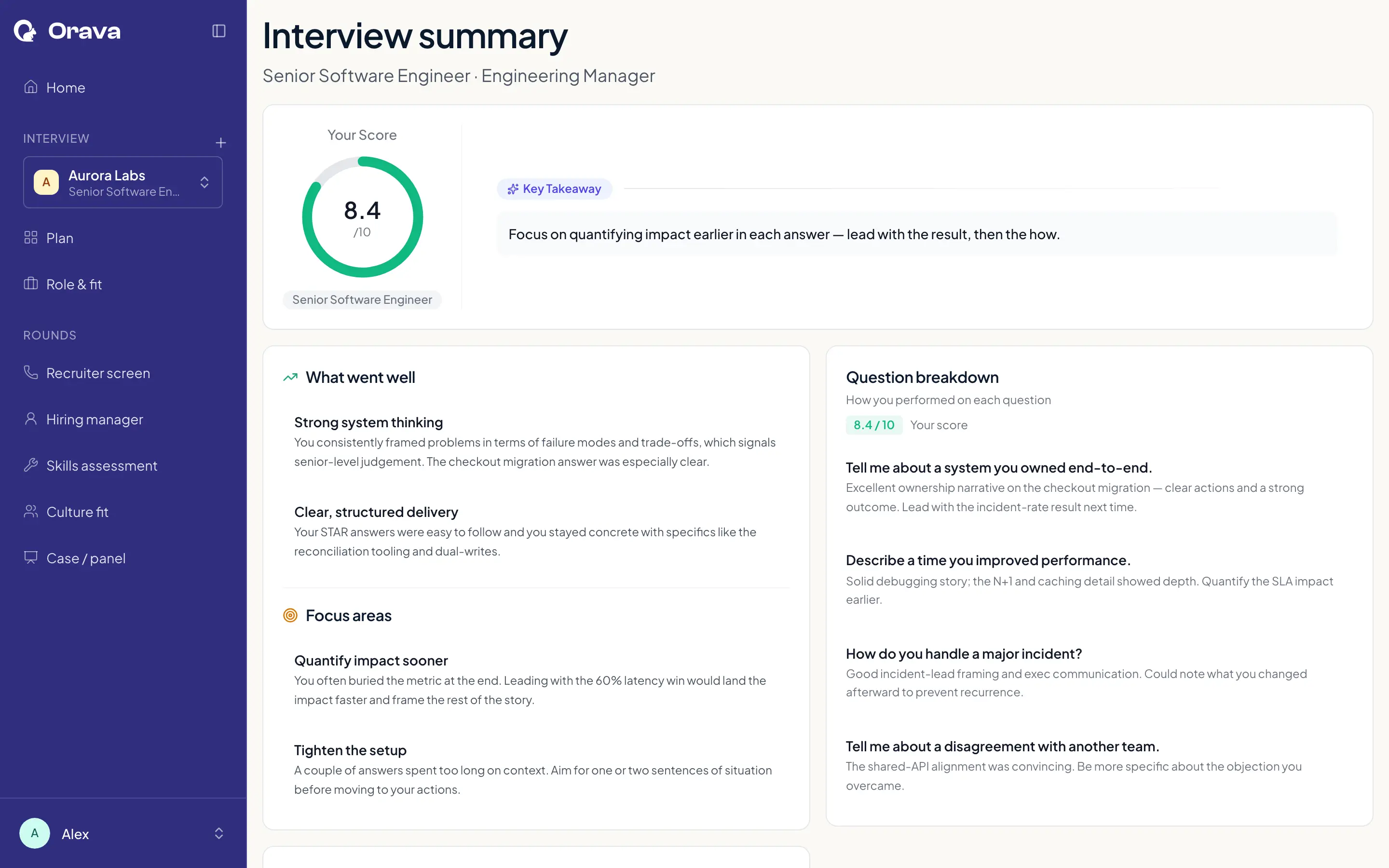
Rehearse this one out loud:
“Tell me about a time you had to debug a production issue that only appeared at scale — one your local testing never caught.”
Preparation Tips for Databricks Software Engineer Interviews
- Get hands-on with Apache Spark, Delta Lake, and MLflow before interviewing — read the Delta Lake transaction log design, not just the marketing description
- Practice diagnosing performance regressions using Spark UI stage and task metrics, not just algorithmic complexity
- Prepare a concrete story about debugging a production issue that only manifested at data scale
- Study how Databricks' Lakehouse pitch differs from a traditional data warehouse or data lake, and be ready to explain the trade-off in your own words
- Practice system design questions that combine storage, concurrency, and distributed compute — not pure algorithms
- Review recent Databricks engineering blog posts for the specific technical problems the team is actively solving
Frequently Asked Questions - Databricks Software Engineer
Third-party interview-prep sources report a 5–6 stage loop over roughly 4–7 weeks: a recruiter screen, a technical coding screen (one main problem with follow-ups), and a virtual onsite covering coding, systems, and behavioral rounds. Experienced candidates sometimes have an added hiring-manager conversation before the onsite, and some senior loops include a live-troubleshooting component. Confirm the exact sequence with your recruiter, since it varies by team.
Live postings across Databricks' engineering teams (Backend, Database Engine Internals, Data Platform, GenAI Performance and Kernel, Infrastructure and Tools) point to strong distributed systems fundamentals, JVM or Rust/C++ systems programming depending on team, SQL and query engine internals, and comfort operating software at large data scale. Practical, implementation-heavy coding is emphasized over abstract algorithm puzzles.
Yes — interview-prep guides consistently report that Databricks probes candidates on Lakehouse architecture, Spark internals, Delta Lake, and MLflow at every level, even for roles not directly on the Spark team, since the whole engineering org builds on top of that stack.
Compared with many software engineering loops, Databricks is reported to probe harder on distributed systems and backend trade-offs, especially for infrastructure-focused and senior roles, and to weight production behavior — concurrency, failure modes, data-intensive workloads at scale — more heavily than pattern-matching coding puzzles.
Strong candidates demonstrate systems thinking under real-world constraints: how a design behaves under concurrent load, what happens when a dependency fails, and how a change performs at data volumes far larger than a laptop can simulate. Genuine familiarity with the Lakehouse platform's own building blocks (Spark, Delta Lake, MLflow) is a differentiator, since much of the day-to-day work extends or hardens that stack.
Sources
Applying for this role?
Paste the Databricks posting and your resume. See which requirements your resume already proves, and which answers to prepare first.
Compare my resume to this roleFree · no account needed


