Shopify Software Engineer Interview Questions & Process (2026)
4 min read11 practice questionsUpdated Sep 29, 2026
Software Engineer interviews test how you reason through a technical problem out loud: the approach you pick, the trade-offs you name and how you check your work. This guide gives cultural fit, behavioral, technical and system design practice questions for the Shopify loop, with notes on how to answer them.
Hear how your answer lands before the interview
“Tell me about a technically challenging problem you solved. What was the problem, your approach, and the outcome?”
Rehearse my answerFree · no account needed
Sample Shopify Software Engineer Interview Questions
Cultural Fit Questions
1 question- 1
How does Shopify's mission to democratise commerce for independent merchants influence how you approach engineering trade-offs?
How to answer: Show merchant-first thinking in technical decisions — e.g., prioritizing checkout reliability over feature velocity, or investing in scalability to serve both small and enterprise merchants on the same platform.
“Tell me about yourself”, “Why here?” and the other common questions, and how to prep each →
Behavioral Questions
3 questions- 1
Tell me about a technically challenging problem you solved. What was the problem, your approach, and the outcome?
How to answer: Use STAR method. Highlight your diagnostic process, how you explored options, the reasoning behind your chosen approach, and how you measured success.
- 2
Describe a time you disagreed with a technical decision made by your team. How did you handle it?
How to answer: Show that you can advocate for your perspective constructively with evidence, respect team decisions, and commit fully once a direction is chosen.
- 3
Tell me about a time you significantly improved the performance or reliability of a system you owned.
How to answer: Quantify the before/after. Walk through how you identified the bottleneck, implemented a fix, validated it, and ensured the improvement held over time.
The six topics behind behavioral questions, and how to prep a story for each →
Technical Questions
4 questions- 1
Walk me through how you would optimize a slow database query affecting checkout performance for high-volume merchants.
How to answer: Cover query analysis (EXPLAIN plans), indexing strategies, read replica routing, query caching, and when to consider denormalisation or a different data access pattern.
- 2
How would you implement a reliable webhook delivery system that guarantees at-least-once delivery for merchant-subscribed events?
How to answer: Discuss event queuing (Kafka/SQS), retry logic with exponential backoff, idempotency keys on the receiver side, dead-letter queues, and monitoring for delivery health.
- 3
Design a GraphQL API for a Shopify storefront that serves product listings, collections, and cart operations for a high-traffic store.
How to answer: Cover schema design, DataLoader for N+1 prevention, pagination (cursor-based vs offset), persisted queries, and rate limiting strategies for API abuse prevention.
- 4
A high-volume Shopify merchant reports intermittent checkout failures on their store. Walk me through your debugging process.
How to answer: Methodically triage: check error logs, trace the request path, review recent deployments, check third-party integrations (payments, shipping), and isolate whether the issue is merchant-specific or broader.
System Design Questions
3 questions- 1
Design a system to handle Shopify's flash sale traffic — a product drop that generates 1M+ requests in the first minute.
How to answer: Cover rate limiting, queue-based order processing to decouple ingestion from fulfillment, inventory reservation with optimistic locking, read-heavy caching strategies, and graceful degradation. Discuss consistency trade-offs during peak load.
- 2
How would you design Shopify's inventory management system to support real-time inventory across thousands of stores and multiple fulfillment channels?
How to answer: Think about multi-channel consistency (web, POS, marketplace), distributed inventory reservation, eventual consistency trade-offs, and how to handle oversell scenarios gracefully.
- 3
How would you approach migrating a critical Shopify service from a monolith to microservices without downtime for merchants?
How to answer: Propose a strangler fig pattern, discuss how to handle dual-write periods, test in shadow mode, maintain backwards compatibility, and plan a safe rollback path.
System design questions grouped by the concept they test, with a full walkthrough →
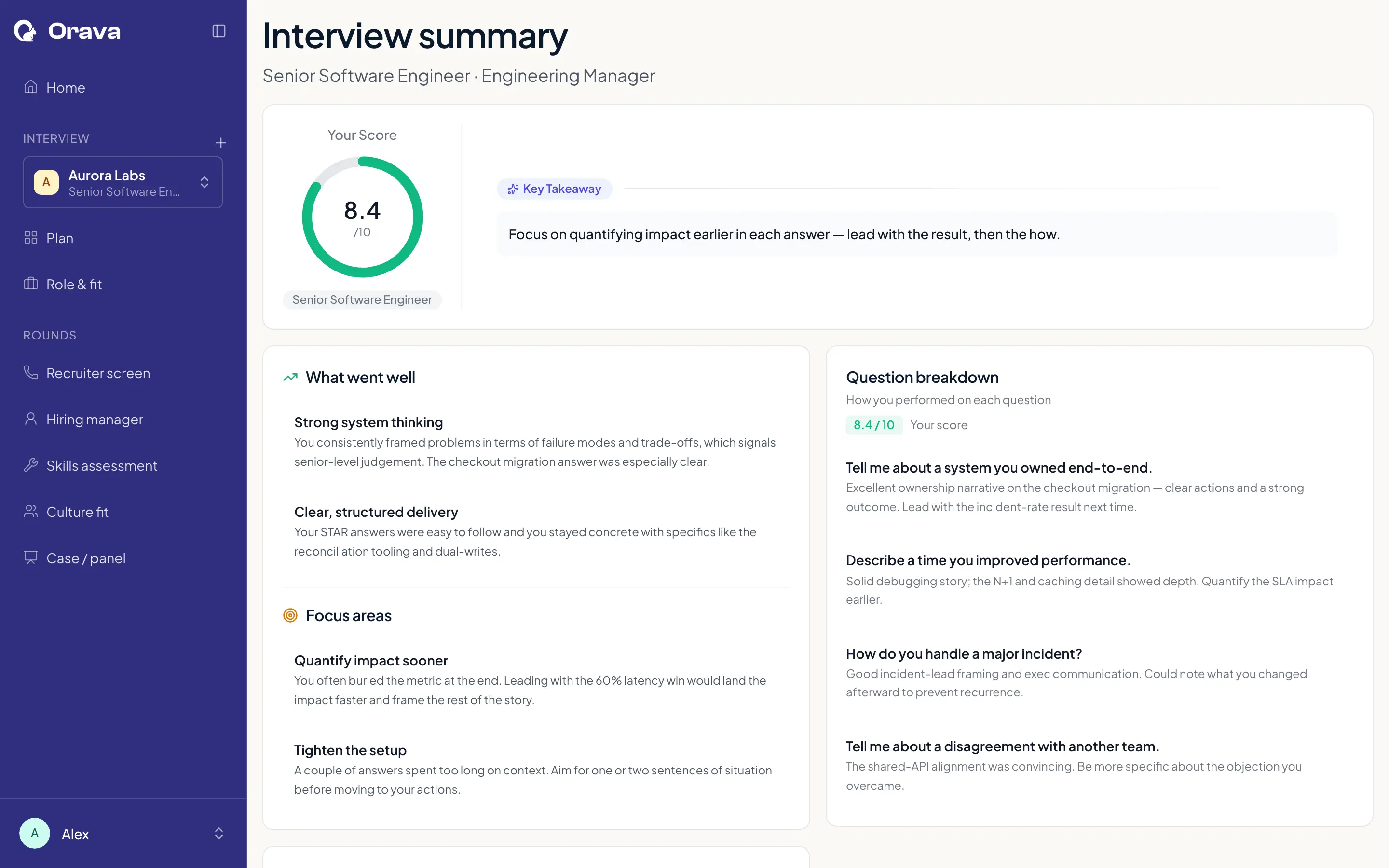
Rehearse this one out loud:
“Tell me about a technically challenging problem you solved. What was the problem, your approach, and the outcome?”
Preparation Tips for Shopify Software Engineer Interviews
- Study Ruby on Rails fundamentals — Shopify's backend is primarily Rails and familiarity demonstrates genuine interest
- Read Shopify's engineering blog to understand their real architecture decisions (MySQL at scale, Kafka, Redis, CQRS)
- Practice system design for high-throughput commerce scenarios: flash sales, order processing pipelines, inventory synchronisation
- Focus on writing clean, well-tested, readable code — Shopify values pragmatic engineering over algorithmic cleverness
- Prepare strong examples of owning and improving a system end-to-end — reliability, performance, and observability stories resonate
- Practice async communication and written technical documentation, as Shopify is a remote-first company with a strong writing culture
Frequently Asked Questions - Shopify Software Engineer
The Shopify SWE process typically includes 4-5 rounds: a recruiter screen (30 min), a technical phone screen with a coding problem (60 min), a system design interview (60 min), a pair programming or take-home project round, and a values/cultural alignment interview. Shopify uses a 'values interview' to assess fit with their autonomous, merchant-focused culture. The process emphasizes practical problem-solving over algorithmic puzzles.
Core skills include: strong fundamentals in backend development (Ruby on Rails is Shopify's primary backend language), distributed systems, database design (MySQL at massive scale), API design (REST and GraphQL), and performance optimization. Frontend experience with React is valued for full-stack roles. Experience with high-throughput, low-latency systems handling commerce transactions is a strong differentiator.
Focus on commerce-scale systems: high-throughput order processing, inventory management, payment systems, and multi-region deployments. Practice designing systems that must handle Flash Sale-level traffic spikes (millions of concurrent users). Understand trade-offs between consistency and availability in distributed commerce systems. Study Shopify's engineering blog for real architecture decisions, including their use of MySQL sharding, Redis, Kafka, and CQRS patterns.
Shopify generally focuses on practical coding challenges over pure algorithmic puzzles. Their take-home projects and pair programming rounds test real-world problem-solving ability — clean code, good abstractions, testing, and handling edge cases. That said, coding fundamentals (data structures, complexity analysis) are still assessed. Preparing with medium-difficulty problems and practicing clean, readable code is the right approach.
Pay varies by level, location and team. Many postings list a base-pay range (US postings in states such as California and New York are required to), so check the posting for your role and ask your recruiter how equity and any bonus work at your level. Shopify is remote-first globally and adjusts compensation to local market benchmarks.
Standout candidates demonstrate pragmatic engineering — they build simple, reliable solutions to hard problems rather than over-engineering. They show ownership mentality, strong written communication (critical in Shopify's async culture), and genuine curiosity about commerce systems. Experience working at scale (high traffic, large datasets) is highly valued, as is comfort shipping incrementally and iterating based on data.
Applying for this role?
Paste the Shopify posting and your resume. See which requirements your resume already proves, and which answers to prepare first.
Compare my resume to this roleFree · no account needed