OpenAI Software Engineer Interview Questions (2026) – Preparation Guide
5 min read13 practice questionsUpdated Sep 29, 2026
Software Engineer interviews test how you reason through a technical problem out loud: the approach you pick, the trade-offs you name and how you check your work. This guide gives cultural fit, behavioral, technical, system design and case study practice questions for the OpenAI loop, with notes on how to answer them.
Hear how your answer lands before the interview
“Tell me about the most technically complex system you've built. What were the hardest engineering challenges?”
Rehearse my answerFree · no account needed
Sample OpenAI Software Engineer Interview Questions
Cultural Fit Questions
1 question- 1
How do you think about building software systems that need to work reliably when they depend on non-deterministic AI model outputs?
Mid-levelHow to answer: Discuss validation layers, fallback mechanisms, deterministic components around non-deterministic model calls, testing strategies for AI-dependent systems, and observability approaches.
“Tell me about yourself”, “Why here?” and the other common questions, and how to prep each →
Behavioral Questions
3 questions- 1
Tell me about the most technically complex system you've built. What were the hardest engineering challenges?
SeniorHow to answer: Choose a genuinely complex example — ideally involving scale, distributed systems, or performance. Walk through the problem space, key design decisions, and what you'd do differently in hindsight.
- 2
Describe a time you had to make an architectural decision under time pressure. How did you approach it?
Mid-levelHow to answer: Show your decision-making framework — how you gathered enough information quickly, evaluated key trade-offs, made the call, and set up mechanisms to revisit it.
- 3
Tell me about a time you disagreed with a technical decision. What happened?
Mid-levelHow to answer: Show you can advocate clearly for your position, engage with counter-arguments fairly, and either change your mind or accept the outcome professionally once a decision is made.
The six topics behind behavioral questions, and how to prep a story for each →
Technical Questions
4 questions- 1
Implement a function to serialize and deserialize a binary tree.
Mid-levelHow to answer: Discuss BFS vs DFS approaches, handling null nodes, edge cases (empty tree, single node), and the time/space complexity of each approach.
- 2
How would you implement an efficient rate limiter for the OpenAI API that handles millions of keys?
Mid-levelHow to answer: Compare token bucket vs sliding window algorithms, discuss Redis-based distributed rate limiting, handling clock skew, and graceful degradation under high load.
- 3
The ChatGPT API is returning 5xx errors for 2% of requests and you're the on-call engineer. Walk me through your incident response.
SeniorHow to answer: Describe your diagnostic process: checking dashboards/traces, forming hypotheses, isolating the failure scope, communicating status, and coordinating a fix. Show clear prioritization under pressure.
- 4
How would you reduce GPU inference costs by 30% without degrading user-facing quality?
SeniorHow to answer: Cover quantization, speculative decoding, prompt caching, dynamic batching, model distillation, and traffic routing by request complexity. Discuss measurement and A/B testing strategy.
System Design Questions
4 questions- 1
Design a system to serve GPT-4 inference at 100,000 requests per second with p99 latency under 2 seconds.
SeniorHow to answer: Cover request routing, load balancing, batching strategies, model sharding/parallelism, caching (for repeated prompts), autoscaling, and circuit breakers. Discuss GPU cluster management.
- 2
Design the ChatGPT streaming API — how do you stream token-by-token responses to thousands of concurrent users?
SeniorHow to answer: Discuss server-sent events vs WebSockets, backpressure handling, connection management, partial failure handling, and how to handle disconnections gracefully.
- 3
Design a distributed pretraining data pipeline that can process and deduplicate 10TB of web-crawled text per day.
SeniorHow to answer: Cover ingestion, quality filtering, deduplication at scale (MinHash/LSH), tokenization, sharding for training, versioning, and reproducibility.
- 4
How would you design a monitoring system to detect when a deployed AI model starts generating unusually harmful or off-policy responses?
SeniorHow to answer: Discuss sampling strategies, automated classifiers, human review queues, alert thresholds, incident response playbooks, and feedback loops for improving detectors.
System design questions grouped by the concept they test, with a full walkthrough →
Case Study Questions
1 question- 1
You're asked to add a feature that would enable users to instruct GPT to take real-world actions (booking flights, sending emails). What are the key engineering and safety challenges?
SeniorHow to answer: Discuss agentic AI safety (irreversible actions, authorization, sandboxing), tool use architecture, error handling when tools fail, audit logging, and how to limit blast radius of mistakes.
Rehearse this one out loud:
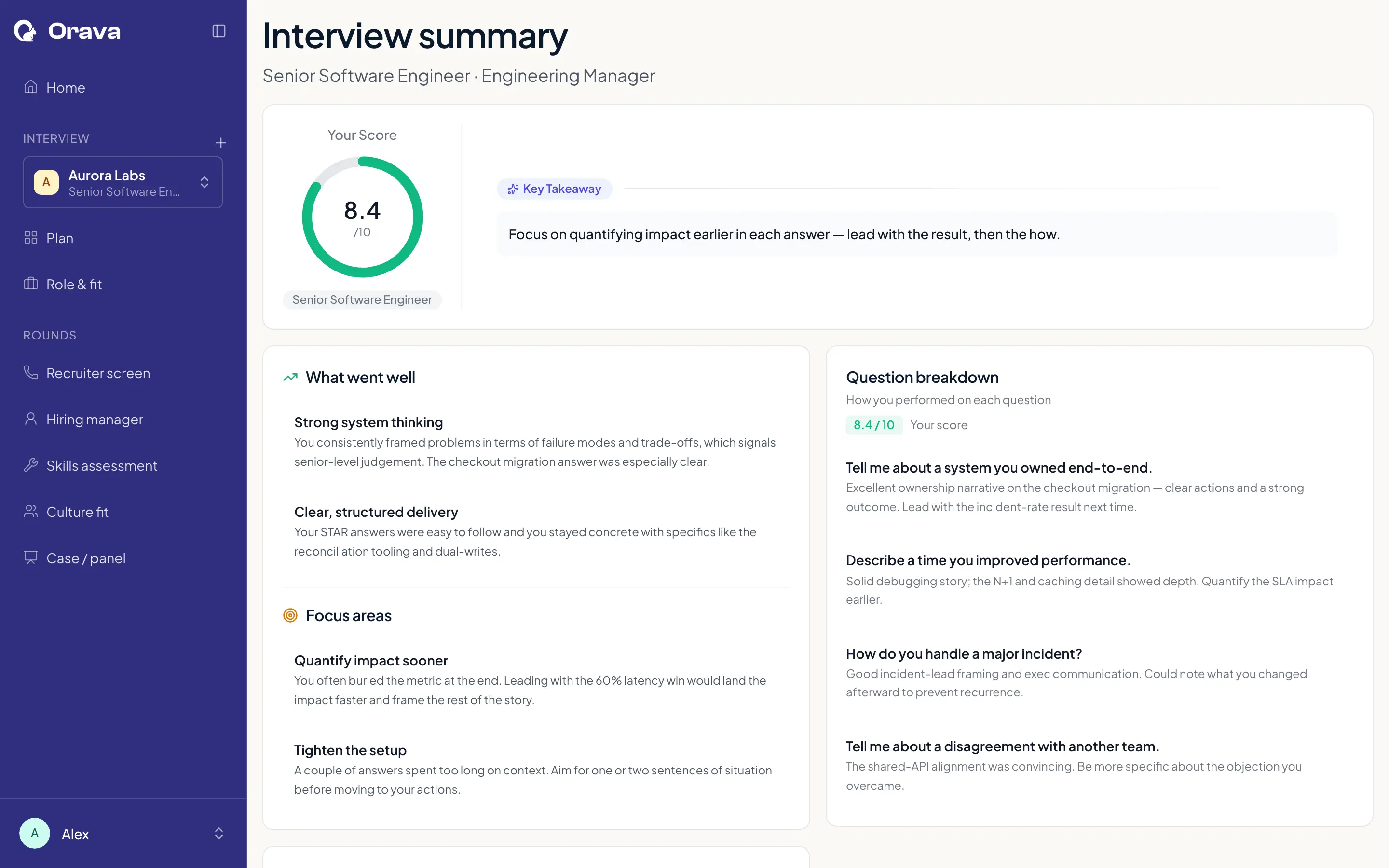
“Tell me about the most technically complex system you've built. What were the hardest engineering challenges?”
Preparation Tips for OpenAI Software Engineer Interviews
- Practice LeetCode medium and hard problems, with emphasis on dynamic programming, graphs, and system design.
- Study distributed systems concepts: consistent hashing, consensus algorithms, distributed tracing, and CAP theorem — they appear regularly.
- Understand LLM inference fundamentals: KV cache, batching, model parallelism, and quantization. Even non-ML roles encounter these.
- Review OpenAI's public engineering blog and research papers to understand the technical challenges the team is actively solving.
- Be ready to discuss how you'd build observable systems: metrics, traces, alerts, and runbooks.
- Prepare a story about handling a complex production incident — investigation, communication, and post-mortem.
- Think through AI-specific system design challenges: how do you test non-deterministic systems? How do you version models in production?
- Be genuine about your interest in AI's impact — OpenAI interviewers want engineers who care about building AI responsibly, not just technically.
Frequently Asked Questions - OpenAI Software Engineer
The process typically includes: recruiter screen (30 min), technical phone interview with coding (45-60 min), take-home coding assignment or live system design (2-4 hrs), onsite virtual loop with 4-5 rounds: two coding rounds (algorithms/data structures), one system design round (distributed systems or ML infrastructure), one behavioral round, and sometimes a safety/values alignment discussion. The entire process can take 3-5 weeks.
OpenAI primarily uses Python for ML, data pipelines, and API services; C++ for performance-critical training and inference code; and TypeScript/JavaScript for web products (ChatGPT). Triton and CUDA are used for GPU kernel development. Most SWE roles require strong Python — systems roles also require C++ or Rust experience.
Common topics include: designing large-scale inference serving systems for LLMs, distributed training pipeline architecture, high-throughput API gateway design, real-time streaming systems (for ChatGPT-style token streaming), data ingestion pipelines for pretraining, and observability systems for AI models. Questions blend classical distributed systems knowledge with ML-specific requirements.
Similar difficulty to FAANG (LeetCode medium/hard level), but with an additional emphasis on writing clean, production-quality code rather than just arriving at a solution. OpenAI interviewers may ask you to walk through error handling, testing strategies, and code maintainability. ML-adjacent coding problems (gradient descent, tokenization, vector operations) appear occasionally.
Pay varies by level, location and team. Many postings list a base-pay range (US postings in states such as California and New York are required to), so check the posting for your role and ask your recruiter how equity and any bonus work at your level.
Yes, though it varies by team. Safety-adjacent teams (policy, research, model behavior) have explicit safety alignment discussions. Product/infrastructure teams typically include one behavioral question about how you think about responsible development. OpenAI increasingly expects engineers to understand the safety implications of their systems, especially those that affect model output or user interactions.
The typical timeline is 4-7 weeks from first contact to offer. Recruiter screens are usually scheduled within 1-2 weeks. The onsite loop happens within 2-3 weeks of the phone screen. Offer and compensation negotiation can add 1-2 weeks. Senior and staff roles may take longer due to additional calibration rounds.
Active hiring areas include: Model Training Infrastructure (scaling training runs), Inference and Serving (optimizing GPT-4/o deployment), ChatGPT product engineering, API Platform (developer tools, SDKs, docs), Safety Systems (content filtering, jailbreak prevention), and Research Engineering (prototyping new model capabilities). Teams vary significantly in culture and day-to-day work.
Applying for this role?
Paste the OpenAI posting and your resume. See which requirements your resume already proves, and which answers to prepare first.
Compare my resume to this roleFree · no account needed